

Why Is Your Outdoor Deck Cracking After Just a Few Seasons?

Author
With years of experience in exterior building materials, I specialize in advanced wood-plastic composite (WPC) technologies. My goal is to help architects, contractors, and project managers navigate the complexities of modern decking solutions. By bridging the gap between structural engineering and sustainable design, I share practical insights to ensure your outdoor projects achieve maximum durability and the best possible ROI.
Alex Carter


It is incredibly frustrating to invest your time and money into building a beautiful backyard oasis, only to watch the floorboards split, splinter, and warp after just one harsh winter or scorching summer. If you find yourself sweeping up wood shards, stepping carefully to avoid nail pops, or looking at ugly fissures running down the length of your deck, you are not alone.
The harsh reality is that the outdoor environment is merciless. Most traditional timber and first-generation plastic materials simply cannot withstand the brutal, unrelenting physics of climate fluctuations. To fix the problem permanently, we have to stop looking at just the color or the price tag of a board, and start looking at its cellular structure and thermal behavior.
The Invisible Forces Tearing Your Deck Apart
There are two primary culprits behind a cracked deck: moisture infiltration and thermal expansion.
Traditional wood is a hygroscopic material, meaning it constantly absorbs and releases moisture from the surrounding air. When rain or melted snow seeps into the wood fibers and the temperature drops below freezing, that trapped water turns into ice. Water expands by roughly 9% when it freezes. This creates immense internal pressure, physically tearing the wood fibers apart from the inside out. After a few freeze-thaw cycles, micro-fractures become massive, visible cracks.
Then comes the heat. Every building material expands when heated and contracts when cooled.When exposed to the summer sun, they would expand drastically. If the installers did not leave massive gaps, the boards would push against each other, buckle upward, and eventually snap under the pressure.
How Modern Extrusion Breaks the Cycle
To stop this cycle of rotting and snapping, the decking industry had to find a way to anchor the material. The solution was Wood Plastic Composite (WPC)—specifically, advanced high-density profiles. By mixing rigid hardwood fibers with flexible, water-resistant polymers (like HDPE) under extreme heat, manufacturers created a hybrid that neutralizes both threats. The plastic encapsulates the wood, cutting off moisture absorption, while the wood fibers stabilize the plastic, drastically lowering the thermal expansion coefficient .
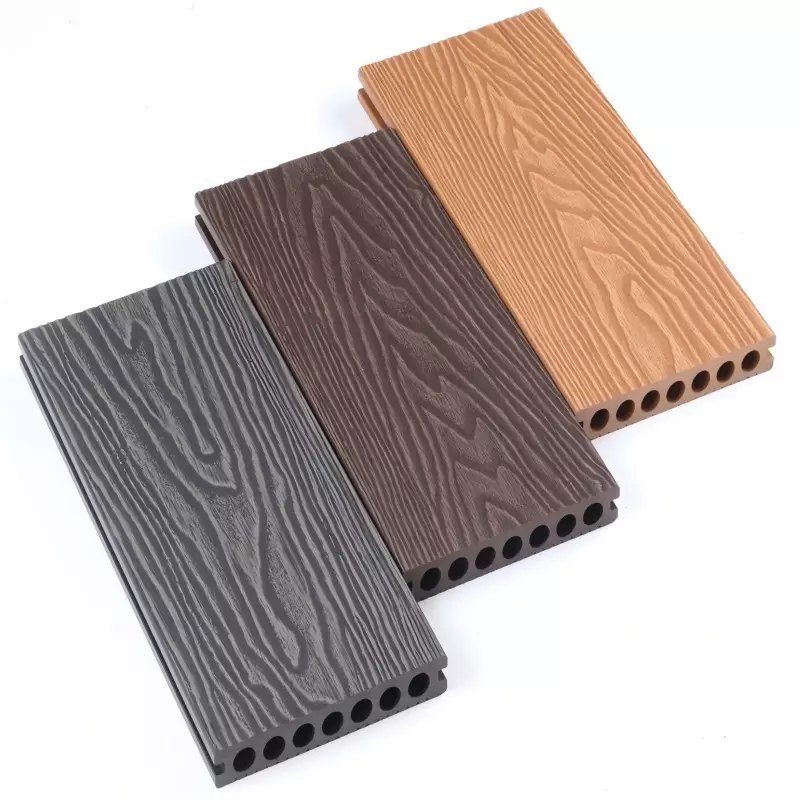
This is exactly why 3D Embossed Composite Decking has become the standard for architectural builds. The "3D embossed" designation isn't just a marketing term for aesthetics. The intense heat and pressure required to stamp that deep, realistic wood grain into the surface actually compresses the top layer of the board. This creates a highly dense, impermeable outer shield that makes it nearly impossible for standing water to penetrate the core.
The Hard Data: Material Performance Under Stress
To understand the practical difference, we need to look at how these materials perform in controlled environmental testing. Below is a comparison of standard outdoor flooring materials subjected to accelerated weathering and stress tests.
Table 1: Environmental Tolerance and Structural Integrity
| Performance Metric | Traditional Pine / Cedar | Early-Gen Smooth Composite | 3D Embossed WPC Decking |
| Water Absorption (24h soak) | > 20% (High rot risk) | 2.5% | < 1.0% (Virtually waterproof) |
| Freeze-Thaw Resistance | Poor (Splinters rapidly) | Moderate (Surface micro-cracks) | Excellent (No structural degradation) |
| UV Degradation (500h exposure) | Fades, becomes brittle | Fades, chalky residue | High Resistance (Retains elasticity) |
| Slip Resistance Rating (Wet) | R9 (Slippery when wet) | R10 | R11 - R12 (High friction texture) |
The data highlights a clear divergence. When a traditional wood deck absorbs 20% of its weight in water, cracking isn't just a possibility; it is a physical certainty. By keeping water absorption under 1%, high-quality WPC entirely bypasses the freeze-thaw destruction mechanism.
The Core Structure: What You Can't See Matters
Sometimes, a deck cracks not because of the weather, but because of weight distribution. Heavy patio furniture, grills, or high foot traffic can cause localized fractures if the board's internal geometry is weak.
When you source a Eco-friendly Wood Plastic Composite, you will notice the ends of the boards are usually not solid blocks. They often feature hollow channels—typically square or circular.
-
Solid Boards: Incredibly strong but very heavy. They retain more heat and are prone to higher thermal expansion simply because there is more mass reacting to the sun.
-
Square Hollow Core: Lighter and cheaper, but the 90-degree internal corners can become stress concentration points. If a heavy impact occurs directly over a square void, the surface is more likely to crack.
-
Circular Hollow Core (Round Holes): This is the engineering sweet spot. Just like arches in Roman aqueducts, circular voids distribute vertical pressure evenly across the structure. They absorb impact forces without snapping, reduce the overall weight on your joists, and allow air to flow through the board, aiding in thermal regulation.
Sun Damage and Surface Temperature
We also cannot ignore the sun. UV radiation destroys the lignin in natural wood and breaks down the polymer chains in cheap plastics, making the boards brittle and powdery. Once a board becomes brittle, simply walking on it can cause the surface to crack.
This is where the surface geometry comes into play. Installing a Textured Embossed Wood Plastic Composite Decking provides a mechanical advantage against the sun. The deep, three-dimensional grain creates thousands of microscopic shadows across the surface of the deck. This texture diffuses direct sunlight rather than absorbing it flat-on like a smooth, glossy plastic board. This slight diffusion, combined with air moving over the textured ridges, actively lowers the surface temperature. Cooler boards experience less thermal stress, and combined with industrial-grade UV inhibitors mixed into the composite core, the deck retains its flexibility and resists cracking for decades.
Installation: The Final Point of Failure
Even the most advanced materials will fail if the physics of the environment are ignored during installation. Over 80% of composite decking failures—specifically buckling and cracking at the ends—are due to improper gapping.
If you do not leave the mathematically required expansion gap between the ends of two boards, they will forcefully collide when the summer heat causes them to expand. The weakest point will always give way, resulting in lifted boards and shattered ends. Always use the manufacturer-provided hidden fasteners, as they are specifically engineered to maintain the exact millimeter gap required for proper thermal movement and water drainage.
Building a deck is a long-term investment, and understanding the environmental stress it will face is the only way to ensure it lasts.
What city are you building this deck in? I can look up your local seasonal temperature extremes and calculate the exact expansion gap you need to leave between the boards to guarantee they never buckle or crack.
- How to Calculate WPC Decking Quantities for Large Projects: Board Coverage, Waste and Accessories
- WPC Decking for Rooftop Terraces: Load Planning, Drainage and Waterproofing Risks
- What Technical Documents Should You Request from a WPC Wall Cladding Manufacturer?
- How to Maintain WPC Wall Cladding Color Consistency in Large Projects
- How to Calculate WPC Wall Cladding Quantities: Panel Coverage, Cutting Waste and Accessories
- WPC Exterior Wall Cladding for Building Renovation: How to Check Substrates, Fixings and Ventilation
- WPC Decking for Hotels and Resorts: How to Choose Materials for Outdoor Areas
- WPC Decking for Commercial Projects: How to Specify Boards for Traffic and Climate