

PVC, Gen 1, or Co-Extruded: Which Commercial Decking Actually Survives the Laws of Physics?


Author
With years of experience in exterior building materials, I specialize in advanced wood-plastic composite (WPC) technologies. My goal is to help architects, contractors, and project managers navigate the complexities of modern decking solutions. By bridging the gap between structural engineering and sustainable design, I share practical insights to ensure your outdoor projects achieve maximum durability and the best possible ROI.
Alex Carter


Table of Contents: Architectural & Engineering Index
- 1. Generation 1 WPC: Hydrostatic Rupture and Cellulose Oxidation
- 2. Cellular PVC: The Mathematics of Thermal Shear Stress
- 3. Co-Extrusion: The Science of Interfacial Melt Bonding
- 4. Identifying Fake Co-Extrusion: The Delamination Trap
- 5. ASTM Standard Specification Matrix
- 6. Supply Chain Physics for Global Procurement
Most architectural specifiers are bombarded with superficial marketing claims regarding outdoor flooring. However, commercial decking failures do not happen because a board "looks bad"—they fail due to quantifiable breakdowns in polymer chain stability, hydrostatic pressure, and unmitigated thermal kinetics.
When evaluating Generation 1 WPC, Cellular PVC, and Co-Extruded composites for large-scale projects, procurement teams must analyze the material science. This document dissects the exact molecular mechanics that dictate why certain materials suffer catastrophic failure, providing a rigorous framework for specifying true High-Traffic Commercial Composite Decking.
1. Generation 1 WPC: Hydrostatic Rupture and Cellulose Oxidation
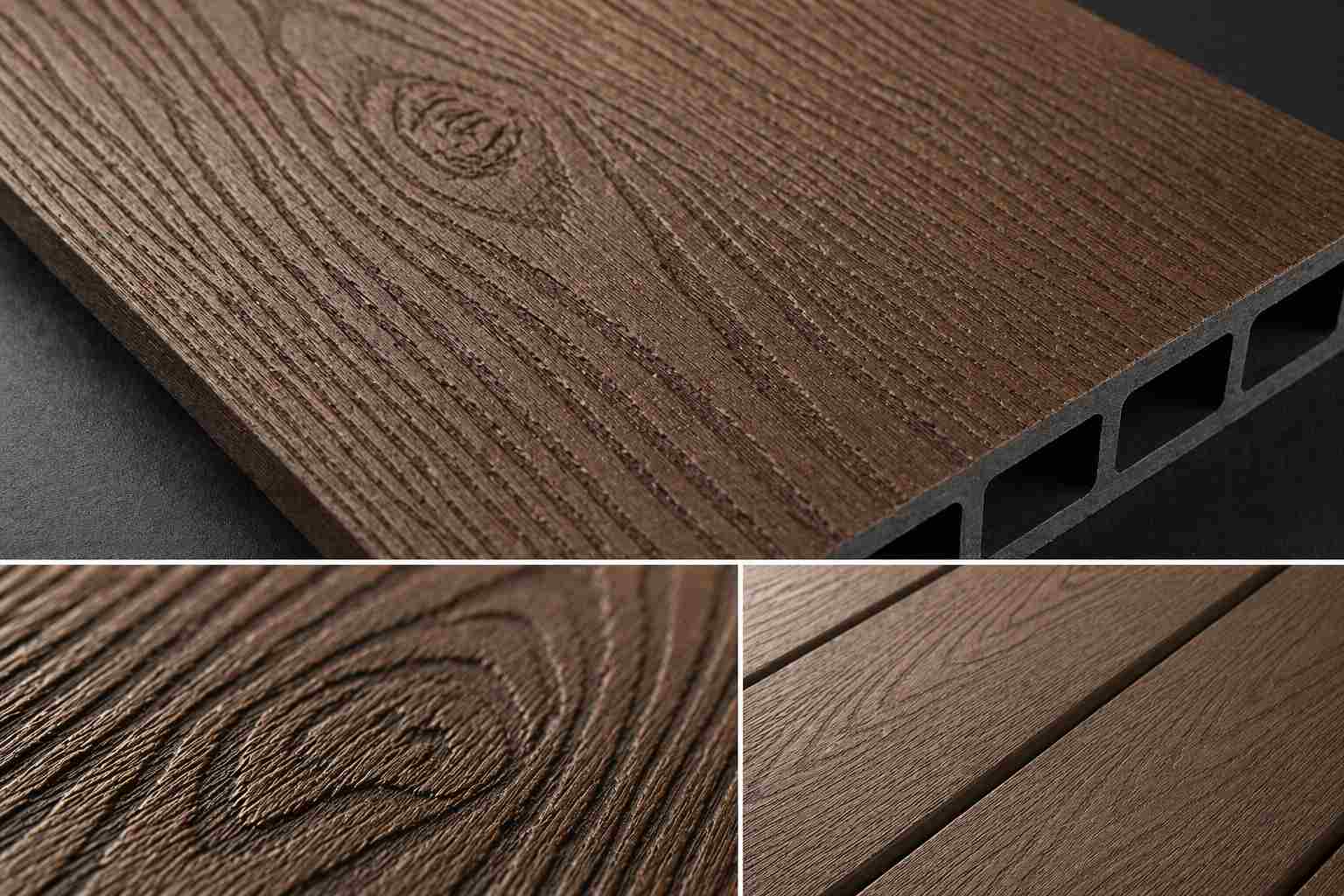
To understand why Generation 1 WPC is being universally phased out of commercial codes, we must look at the microscopic structure of the board. Gen 1 materials are mono-extruded, meaning the wood flour and polyethylene (PE) are uniformly mixed and pushed through a die. This inevitably leaves cellulosic wood fibers exposed on the exact wearing surface of the board.
The Hydrostatic Failure Mechanism: Wood fibers are inherently hygroscopic (water-absorbing). When ambient moisture or rain hits a Gen 1 board, capillary action draws water deep into the core structure. When environmental temperatures drop below 0°C, the trapped water freezes and expands by approximately 9%. This generates immense internal hydrostatic pressure that fractures the surrounding polymer matrix. After multiple freeze-thaw cycles, the board develops micro-cracks, leading to irreversible structural degradation.
Photo-Oxidation: Furthermore, exposed lignin (the organic glue in wood fibers) reacts violently with UV radiation. Without a protective shield, the UV rays break the carbon-carbon bonds within the polymer chain, a process known as photo-oxidation. This is the chemical reason why Gen 1 boards suffer from heavy "chalking"—the polymer turns to dust and washes away, leaving faded, grey wood fibers behind.
2. Cellular PVC: The Mathematics of Thermal Shear Stress
Cellular PVC attempts to solve the moisture issue by entirely removing the wood fiber. While this creates a 100% waterproof board, it introduces a catastrophic vulnerability: extreme thermodynamic instability.
In material science, wood fibers act as the "rigid skeleton" of a composite board. By removing them, Cellular PVC behaves purely as an elastic plastic. The critical engineering failure point for PVC is its Linear Coefficient of Thermal Expansion (LCTE).
In physics, thermal expansion is calculated by the formula:
Where ΔL is the change in length, α is the expansion coefficient, L0 is the original length, and ΔT is the temperature change. Because the α value of PVC is exceptionally high, a 20-foot commercial board subjected to a 40°C temperature swing (from a cool morning to direct afternoon sun) will violently expand.
This expansion generates massive kinetic shear stress against the substructure. If the board is installed with standard hidden fasteners, the expanding PVC will act like a lever, systematically snapping the stainless-steel screws or buckling upward off the joists. This is why PVC is heavily restricted in regions with high diurnal temperature variations.
3. Co-Extrusion: The Science of Interfacial Melt Bonding
The engineering triumph of Gen 2 decking lies in its composite architecture. It retains the dense, wood-fiber core (which provides the low LCTE and high structural Modulus of Rupture needed for heavy loads) while simultaneously applying a 360-degree shield of Advanced Capped Polymer Technology to neutralize moisture and UV threats.
However, the secret to true co-extrusion is Interfacial Adhesion. The protective cap is not glued on. During the twin-screw manufacturing process, the core mixture (at ~180°C) and the capstock polymer (at ~200°C) are pushed through the extrusion die simultaneously. Because the thermoplastic matrices of both layers are chemically compatible, polymer chain entanglement occurs at the interface. They fuse into a single monolithic entity at the molecular level, meaning the cap cannot be physically separated from the core without destroying the board.
4. Identifying Fake Co-Extrusion: The Delamination Trap
This is where commercial buyers often fall into procurement traps. To cut costs, low-tier factories will use mismatched polymers for the core and the cap (e.g., trying to bond a PE core with a cheap PVC cap).
Because these two materials have vastly different Melt Flow Indexes (MFI) and cooling shrinkage rates, true molecular entanglement never occurs. This results in a phenomenon known as Delamination. After a single summer of thermal stress, the outer shield of a cheap co-extruded board will blister, crack, and peel off like dead skin, instantly exposing the vulnerable core and voiding the entire project. Sourcing teams must demand ISO-certified pull-off adhesion testing before bulk purchasing.
5. ASTM Standard Specification Matrix
The following data matrix references standard ASTM testing protocols to provide a stark, quantifiable contrast between the three materials.
| Engineering Metric | Gen 1 WPC | 100% Cellular PVC | Co-Extruded WPC |
|---|---|---|---|
| Water Absorption (ASTM D1037) | Up to 3.5% (Capillary risk) | 0.0% | < 0.2% (Effectively zero) |
| Thermal Expansion Rate (LCTE) | 15 - 25 × 10-6 / °C | 50+ × 10-6 / °C (Severe) | 10 - 20 × 10-6 / °C (Stable) |
| Modulus of Elasticity (Creep Resistance) | Excellent | Poor (Requires tight joists) | Excellent |
| UV Photodegradation Resistance | High failure rate | Excellent | Excellent (HALS matrix) |
| Interfacial Bond Strength | N/A (Mono-extruded) | N/A | Covalent-like entanglement |
6. Supply Chain Physics for Global Procurement
For global distributors and architectural specifiers, making the wrong material selection is a geometric risk. Selling a material that lacks thermal stability (PVC) into a desert climate, or a material with high capillary action (Gen 1) into a freezing coastal zone, guarantees total project failure and severe litigation.
By scrutinizing the physics, the logical path for procurement becomes absolute. Partnering with a vetted Wholesale Co-Extrusion Decking Manufacturer mitigates these precise molecular failures. By utilizing materials that balance dense organic tensile strength with impermeable polymer capstock geometry, distributors eliminate callback liabilities and guarantee structural longevity for their commercial clientele.
- How to Calculate WPC Decking Quantities for Large Projects: Board Coverage, Waste and Accessories
- WPC Decking for Rooftop Terraces: Load Planning, Drainage and Waterproofing Risks
- What Technical Documents Should You Request from a WPC Wall Cladding Manufacturer?
- How to Maintain WPC Wall Cladding Color Consistency in Large Projects
- How to Calculate WPC Wall Cladding Quantities: Panel Coverage, Cutting Waste and Accessories
- WPC Exterior Wall Cladding for Building Renovation: How to Check Substrates, Fixings and Ventilation
- WPC Decking for Hotels and Resorts: How to Choose Materials for Outdoor Areas
- WPC Decking for Commercial Projects: How to Specify Boards for Traffic and Climate