

The Real ROI of Co-Extruded Decking: A 10-Year Cost Analysis for Contractors


Author
With years of experience in exterior building materials, I specialize in advanced wood-plastic composite (WPC) technologies. My goal is to help architects, contractors, and project managers navigate the complexities of modern decking solutions. By bridging the gap between structural engineering and sustainable design, I share practical insights to ensure your outdoor projects achieve maximum durability and the best possible ROI.
Alex Carter


Table of Contents: In-Depth Comparison
- 1. The Material Science: Solid Wood vs. Co-Extruded Composites
- 2. Comprehensive Technical Feature Comparison
- 3. Installation Economics: Labor Time and Fastening Systems
- 4. The Hidden Drain: Annual Maintenance Expenditure
- 5. The 10-Year TCO & ROI Financial Model
- 6. Eliminating Callback Liability in Commercial Bids
In the commercial construction and landscaping sectors, the materials specified on a blueprint dictate the long-term profitability of a project. For decades, pressure-treated pine and exotic hardwoods have been the default choices for outdoor flooring. However, modern commercial clients—from hospitality groups to municipal developers—are shifting their focus away from initial bid prices and demanding a rigorous analysis of the Total Cost of Ownership (TCO).
To win high-value bids, contractors must articulate exactly how advanced material science impacts both immediate installation labor and a decade of operational expenses. This comprehensive technical and financial analysis breaks down exactly how co-extrusion technology alters the physics of outdoor flooring and redefines project ROI.
1. The Material Science: Solid Wood vs. Co-Extruded Composites
Traditional solid wood is inherently hygroscopic. Its cellular structure is designed by nature to absorb and release moisture. In a living tree, this is necessary; in a milled deck board, it is a fatal flaw. When exposed to rain, snow, and UV radiation, wood fibers expand, contract, and eventually rupture.
First-generation composite boards solved the rot issue by mixing wood fibers with plastics, but they still suffered from surface staining and slow color fading because the core material was partially exposed.
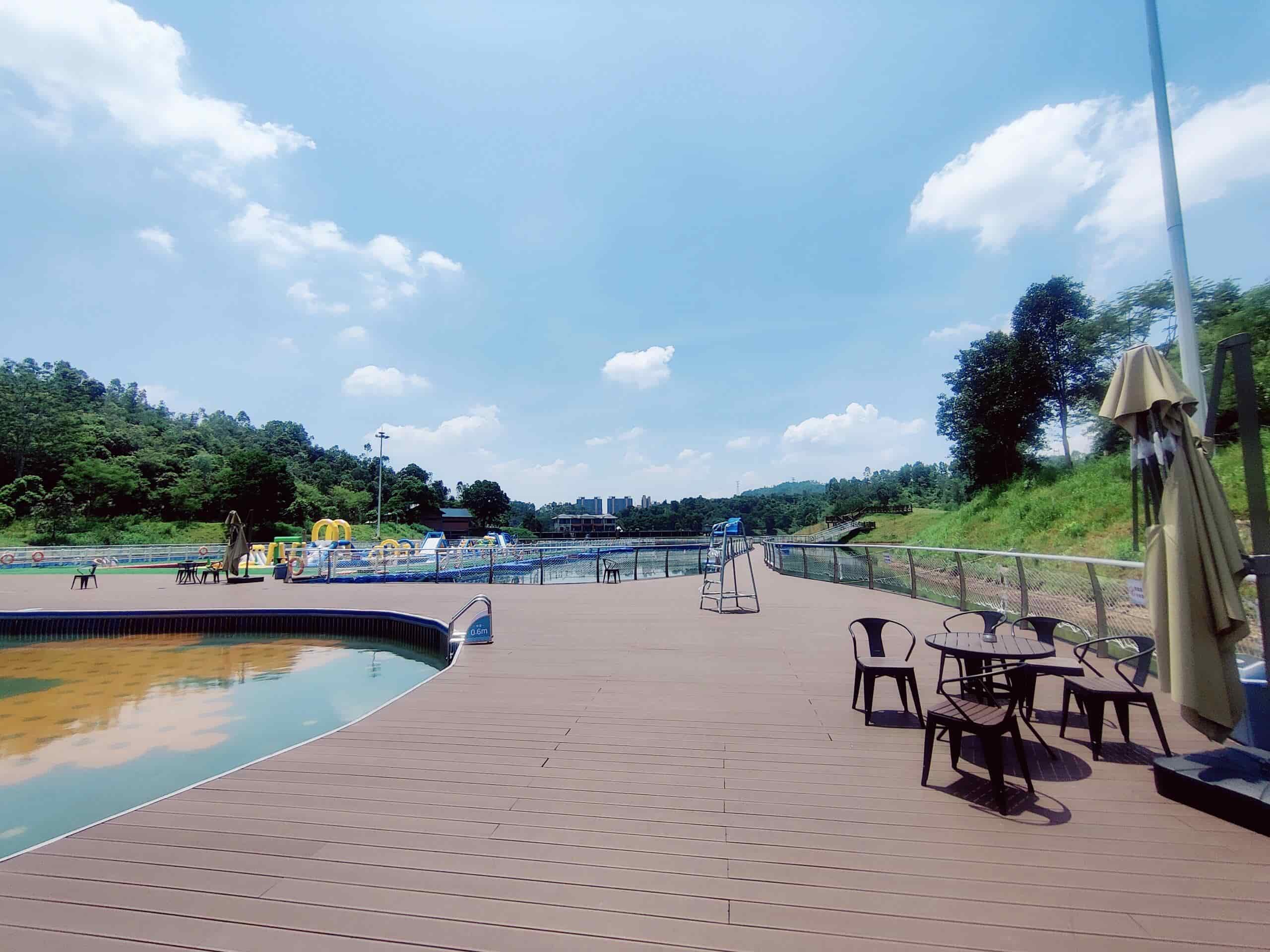
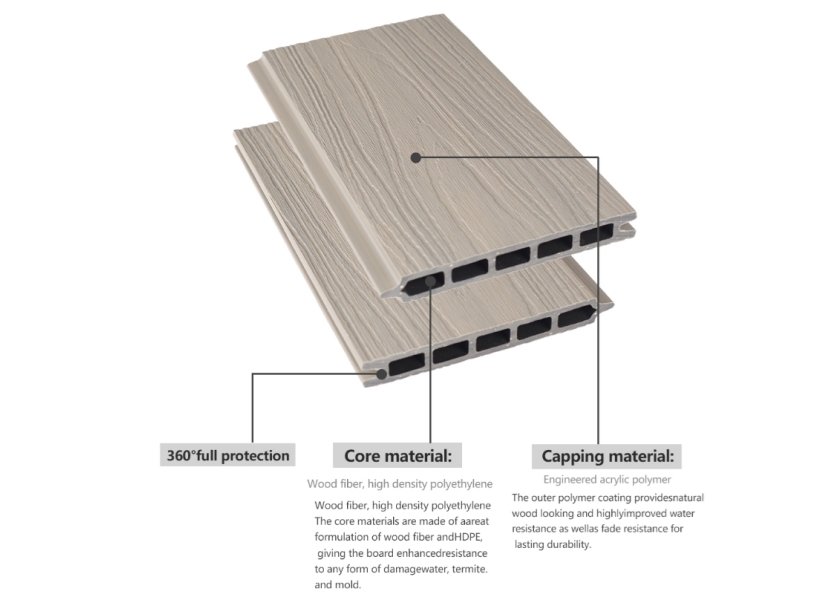
High-performance WPC Co-extrusion Decking represents a monumental leap in polymer engineering. During manufacturing, a rigid composite core (made from recycled hardwood fibers and high-density polyethylene) is simultaneously extruded with a 360-degree pure polymer shield. This outer "cap" is mechanically bonded to the core at extreme temperatures. The result is a board with the tensile strength of dense wood, but with an outer layer that is completely non-porous and chemically inert.
2. Comprehensive Technical Feature Comparison
Before discussing financial models, it is critical to understand the physical behaviors that drive those costs. For architects and specifiers, material durability in severe weather is the primary concern.
Technical Specifications: Environmental Stress Tolerance
| Performance Metric | Solid Wood (Treated Pine / Cedar) | Co-Extruded (Capped) WPC |
|---|---|---|
| Water Absorption (24h Immersion) | 20% - 35% (High risk of warping) | < 0.5% (Impermeable shield) |
| UV Fading & Discoloration | Turns silver/grey within 8-12 months | High color retention (Delta E < 3.0 over 10 years) |
| Fungal Decay & Insect Damage | Highly susceptible; requires toxic chemical treatment | 100% impervious to termites and mold |
| Surface Stain Resistance | Absorbs oils, wine, and grease instantly | Wipes clean; stains cannot penetrate the polymer cap |
This table illustrates why commercial properties—such as restaurant patios or public boardwalks—experience massive depreciation when utilizing natural timber. The cellular breakdown of wood guarantees ongoing structural failure, whereas the engineered capstock of composite boards actively resists molecular degradation.
3. Installation Economics: Labor Time and Fastening Systems
When evaluating project costs, material price per square meter is only half the equation. Labor hours account for a massive portion of the initial bid.
Installing a traditional wood deck is incredibly labor-intensive. Boards must be hand-sorted for crowning and bowing. Installers must manually measure expansion gaps, pre-drill holes (particularly with hardwoods like Ipe), and drive thousands of face-screws. Following the installation, the crew must often return to apply a waterproofing sealant once the wood has acclimated.
Premium Commercial-Grade Capped Composite Decking fundamentally changes site logistics. Because the boards are manufactured via extrusion, they are perfectly straight and dimensionally uniform. There is no sorting required. More importantly, these boards are engineered with side grooves designed for hidden fastening systems.
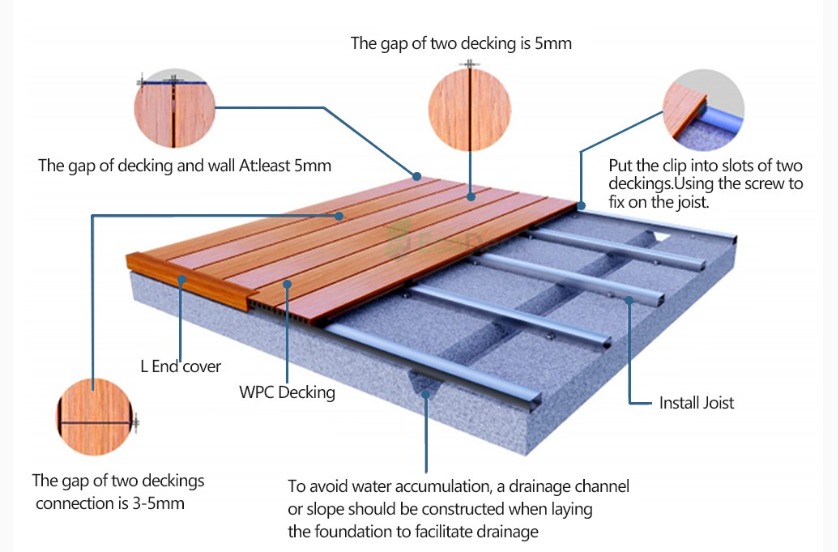
Installers simply slide a stainless steel or heavy-duty nylon clip into the groove, which automatically establishes the exact 5mm to 6mm thermal expansion gap required. This eliminates the need for manual spacing and face-drilling. On commercial sites measuring over 500 square meters, time-motion studies indicate that hidden fastener systems reduce flooring installation labor hours by 25% to 35%.
4. The Hidden Drain: Annual Maintenance Expenditure
The most catastrophic miscalculation in commercial decking projects occurs in the operational budget. Wood requires an aggressive, compounding maintenance schedule. To maintain structural integrity and a safe walking surface, a timber deck in a four-season climate requires the following cycle:
- Annually: Power-washing and visual inspection for popped nails and splinters.
- Every 2-3 Years: Chemical stripping or heavy mechanical sanding to remove the degraded top layer of wood fibers.
- Every 2-3 Years: Application of high-grade industrial stains and UV-resistant sealants.
- Year 5-7: Targeted replacement of boards that have cupped, cracked, or succumbed to hidden joist rot.
For a hotel or municipal property, this is not just the cost of sealant; it is the cost of specialized labor and the loss of revenue while the area is closed off to the public for chemical application. Co-extruded boards eliminate this cycle. The polymer shield requires no sanding, painting, or sealing—ever. The maintenance protocol is reduced to a standard bi-annual cleaning with a mild soap solution and a low-pressure hose.
5. The 10-Year TCO & ROI Financial Model
To properly advise a client, contractors must present a Total Cost of Ownership (TCO) model. The upfront price tag of co-extruded material is higher—often 30% to 50% more than pressure-treated pine, though frequently cheaper than premium exotics like Teak or Ipe.
10-Year Cumulative Cost Comparison (Based on 100 SQM)
| Financial Milestone | Solid Wood Decking | Co-Extruded WPC Decking |
|---|---|---|
| Initial Material Cost | $4,500 | $8,200 |
| Initial Installation Labor | $3,200 | $2,400 (Hidden clip efficiency) |
| Year 0 Total Investment | $7,700 | $10,600 |
| Est. Annual Maintenance | $850 (Sanding, staining, sealing) | $120 (Basic wash) |
| Cumulative Cost: Year 3 | $10,250 | $10,960 |
| Cumulative Cost: Year 4 (Crossover) | $11,100 | $11,080 |
| Cumulative Cost: Year 7 | $13,650 | $11,440 |
| Total Output: Year 10 | $16,200 | $11,800 |
The mathematical reality is undeniable. By Year 4, the initial savings of the wood deck have been completely erased by maintenance labor and chemical supplies. By Year 10, the property owner has lost over $4,400 per 100 square meters by choosing timber. Furthermore, at the decade mark, the timber deck will visually look its age and may require structural board replacements. The co-extruded material, backed by industrial warranties, will continue to perform flawlessly without additional capital injection.
6. Eliminating Callback Liability in Commercial Bids
For contractors, ROI extends beyond the client’s wallet—it directly impacts your firm's operational margins. In the construction industry, post-installation callbacks are margin killers. Dispatching a crew to replace a warped pine board or address popped nails eats directly into the profit realized from the initial bid.
Specifying advanced polymer composites acts as a liability shield. The rigid extrusion process severely limits the Linear Coefficient of Thermal Expansion (LCTE), preventing extreme buckling. The polymer cap guarantees no splintering, ensuring the project meets strict public safety regulations and eliminates slip-and-fall hazards associated with degrading timber.
By presenting a transparent TCO analysis, contractors transition from competing on a race-to-the-bottom bid price to acting as strategic project consultants. Furthermore, sourcing directly from a reliable Factory-Direct Wholesale Composite Decking manufacturer ensures you lock in aggressive factory pricing, maximizing your margin on materials while delivering a mathematically superior, zero-maintenance asset to your client.
- How to Calculate WPC Decking Quantities for Large Projects: Board Coverage, Waste and Accessories
- WPC Decking for Rooftop Terraces: Load Planning, Drainage and Waterproofing Risks
- What Technical Documents Should You Request from a WPC Wall Cladding Manufacturer?
- How to Maintain WPC Wall Cladding Color Consistency in Large Projects
- How to Calculate WPC Wall Cladding Quantities: Panel Coverage, Cutting Waste and Accessories
- WPC Exterior Wall Cladding for Building Renovation: How to Check Substrates, Fixings and Ventilation
- WPC Decking for Hotels and Resorts: How to Choose Materials for Outdoor Areas
- WPC Decking for Commercial Projects: How to Specify Boards for Traffic and Climate