

Why is WPC Classic Decking the Superior Choice for Challenging Outdoor Environments?


Author
With years of experience in exterior building materials, I specialize in advanced wood-plastic composite (WPC) technologies. My goal is to help architects, contractors, and project managers navigate the complexities of modern decking solutions. By bridging the gap between structural engineering and sustainable design, I share practical insights to ensure your outdoor projects achieve maximum durability and the best possible ROI.
Alex Carter


For modern architects and commercial developers, the outdoor environment is a relentless testing ground. High-performance projects in coastal regions, high-altitude zones, or tropical climates require more than just an aesthetically pleasing "wood-look" surface; they demand technical resilience.
The true test of an outdoor flooring solution doesn't happen on the day of installation—it happens after five seasons of intense UV exposure and heavy monsoon rains. This guide explores the engineering behind Wood-Plastic Composites (WPC) and how specific manufacturing breakthroughs solve the most common failure points in extreme environments.
1. Hydro-Expansion Control: The Science of Fiber Encapsulation
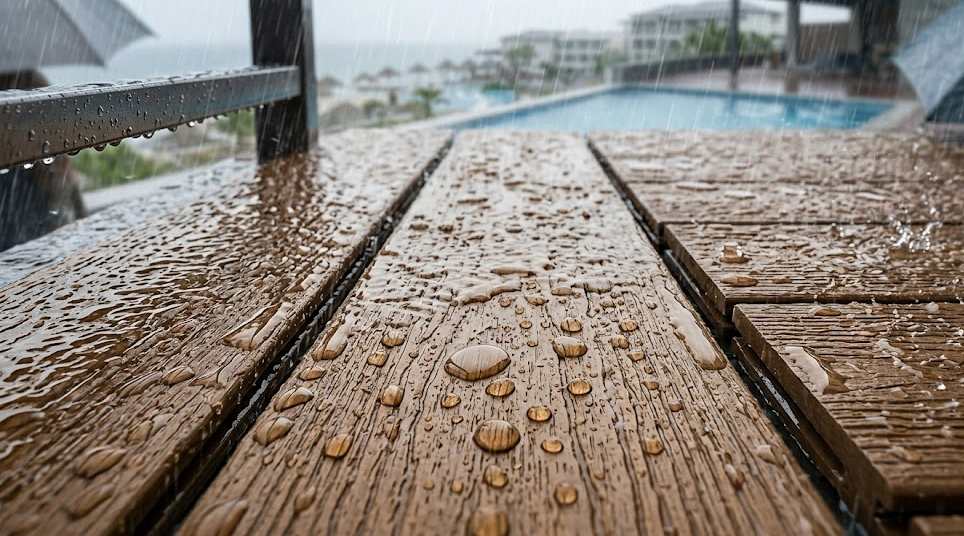
The most frequent technical failure in traditional outdoor materials is dimensional instability. When organic fibers absorb moisture, they swell at a cellular level, leading to internal delamination and warping. While WPC is inherently more stable than timber, its resilience is dictated by the quality of Fiber Encapsulation.
In premium manufacturing, each individual wood fiber is microscopically coated in High-Density Polyethylene (HDPE) during the extrusion process. This creates a hydrophobic barrier that limits water absorption to negligible levels. By choosing Premium WPC Classic Decking engineered with full encapsulation, developers ensure that even in high-humidity areas like poolside surrounds or beachfront boardwalks, the boards maintain their original geometry without "tenting" or buckling.
Technical Comparison: Moisture Absorption & Structural Impact (24h soak)
| Material Category | Weight Gain (24hr) | Expansion Risk |
| Untreated Softwood | 25% - 40% | Critical / Immediate Warping |
| Exotic Hardwood | 8% - 12% | Moderate / Seasonal Checking |
| Standard WPC | 1.5% - 3% | Low / Minimal Expansion |
| High-Performance WPC | < 1% | Negligible / Full Stability |
2. UV Protection: Preventing Photodegradation via Capping
Ultraviolet radiation is a silent destroyer. UV rays break the molecular bonds of plastic polymers in a process known as photodegradation, which leads to "chalking," surface brittleness, and severe color loss. To combat this, Wholesale Co-extrusion Decking utilizes a 360-degree protective shield.
This co-extruded cap is not just a thin skin; it is a high-density polymer layer integrated with Hindered Amine Light Stabilizers (HALS). These chemical agents act as "radical scavengers," trapping the free radicals produced by UV exposure. This technology ensures that projects in high-UV regions (such as high-altitude resorts) retain their design intent for decades.
3. The Engineering of Friction: Safety in High-Moisture Areas
Safety class is a non-negotiable technical requirement for public and commercial spaces. While many standard composite boards rely on a "sanded" finish that can wear smooth, Deep-Grain 3D Embossed WPC Decking provides a permanent solution. Unlike printed wood grains, 3D embossing is heat-pressed during cooling to create a structural, tactile grain that provides mechanical "bite" for footwear.
Friction Ratings (Pendulum Test Value - PTV)
| Surface Texture | Condition: Wet | Safety Classification |
| Sanded Surface | 32 PTV | Moderate Risk when wet |
| Standard Embossing | 38 PTV | Low Risk |
| Deep 3D Embossing | 46 PTV | High Safety / Public Grade |
4. Structural Integrity: MOR and Load-Bearing
For commercial walkways, the stiffness of the board is critical to preventing "bounce" and clip failure. This is determined by the Modulus of Rupture (MOR). High-performance WPC utilizes long-chain polymer blends to increase the flexural modulus. In practical terms, this allows for a center-to-center joist spacing of 350mm to 400mm, providing a rock-solid walking surface that can handle concentrated loads exceeding 450kg without permanent deformation.
5. Managing Thermal Expansion: The LCTE Factor
A common cause of deck failure is the failure to account for the Linear Coefficient of Thermal Expansion (LCTE). WPC boards expand and contract as temperature fluctuates. Technical-grade boards are designed with a predictable LCTE (typically 0.03mm to 0.05mm per meter per degree Celsius). By using hidden fastening systems that allow the boards to "float" rather than being screwed rigidly, the deck can breathe seasonally.
6. The Bio-Barrier: Preventing Fungal Colonization
In tropical zones, mold requires moisture, heat, and a food source (cellulose). Since WPC contains wood fiber, it must be rendered inedible. Premium boards integrate mineral-based biocides, such as Zinc Borate, directly into the core. Combined with low surface porosity, this ensures that the boards remain free from the structural rot that plagues traditional timber.
Technical FAQ for Specifiers
- Do these boards require special tools?
No. High-performance WPC can be cut and drilled with standard woodworking tools. Carbide-tipped blades are recommended for the cleanest edges. - Is WPC resistant to pool chemicals?
Yes. The HDPE polymer shield is chemically inert to chlorine and salt water, making it ideal for poolside applications. - How does 3D embossing affect cleaning?
While the grain is deep, the closed-cell nature of the polymer means dirt does not penetrate. A simple pressure wash or scrub maintains its clarity.
Building a deck is a long-term investment. By prioritizing these engineering realities over simple aesthetics, developers can ensure that the outdoor environment remains a curated space of beauty and safety for decades.
- How to Calculate WPC Decking Quantities for Large Projects: Board Coverage, Waste and Accessories
- WPC Decking for Rooftop Terraces: Load Planning, Drainage and Waterproofing Risks
- What Technical Documents Should You Request from a WPC Wall Cladding Manufacturer?
- How to Maintain WPC Wall Cladding Color Consistency in Large Projects
- How to Calculate WPC Wall Cladding Quantities: Panel Coverage, Cutting Waste and Accessories
- WPC Exterior Wall Cladding for Building Renovation: How to Check Substrates, Fixings and Ventilation
- WPC Decking for Hotels and Resorts: How to Choose Materials for Outdoor Areas
- WPC Decking for Commercial Projects: How to Specify Boards for Traffic and Climate