

WPC Decking for Hotels and Resorts: How to Choose Materials for Outdoor Areas


Author
With years of experience in exterior building materials, I specialize in advanced wood-plastic composite (WPC) technologies. My goal is to help architects, contractors, and project managers navigate the complexities of modern decking solutions. By bridging the gap between structural engineering and sustainable design, I share practical insights to ensure your outdoor projects achieve maximum durability and the best possible ROI.
Alex Carter


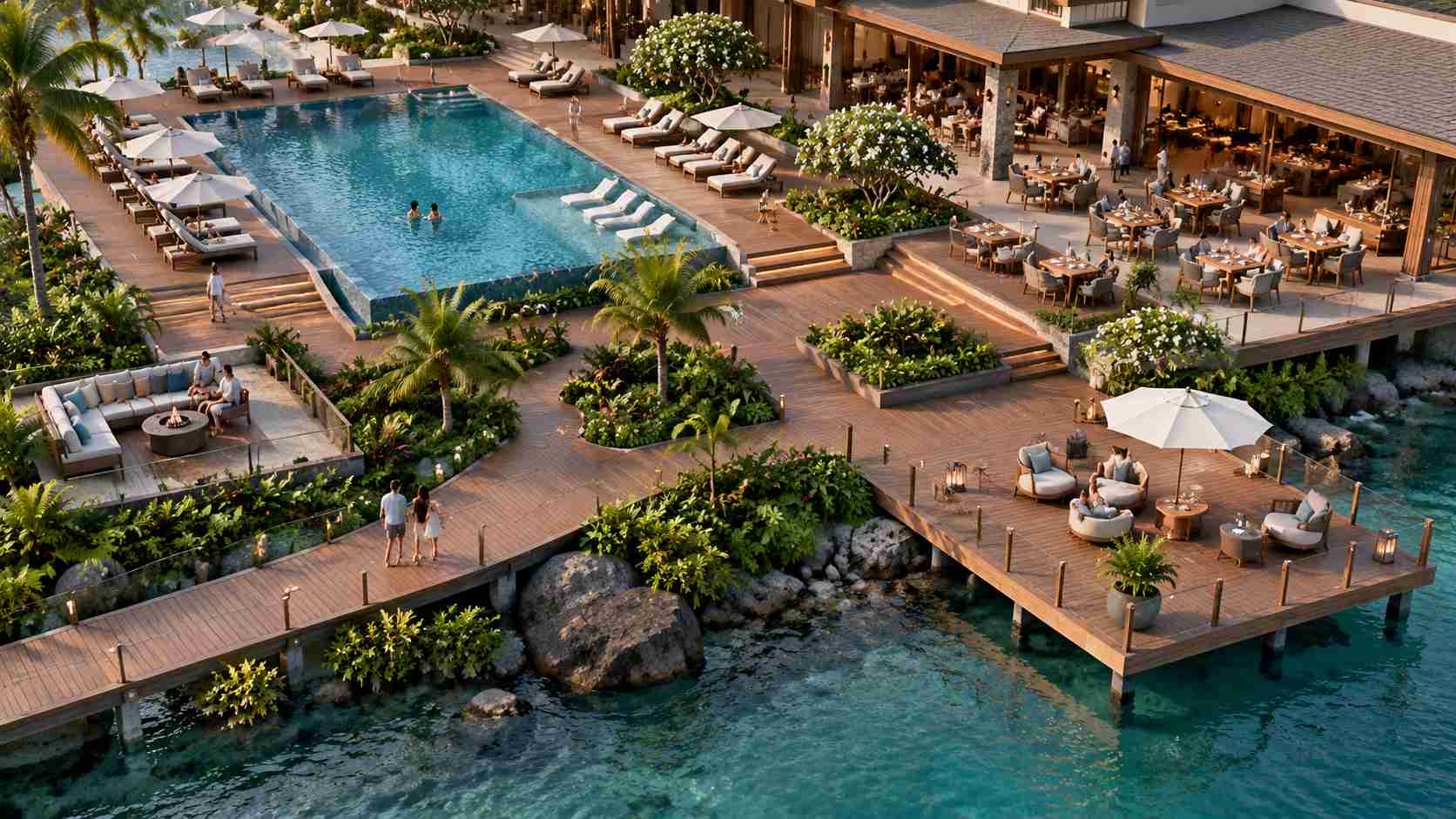
Hotels and resorts use outdoor decking in very different environments: pool decks, guest terraces, restaurant patios, garden walkways, waterfront platforms and recreational areas. Although these applications may use the same basic WPC material, they do not have the same performance requirements.
For hotel and resort projects, the right decking specification needs to balance guest traffic, climate exposure, appearance, cleaning frequency, safety and installation requirements. A board that works well on a private residential terrace may not be the right choice for a busy resort walkway or outdoor restaurant.
This guide focuses on how project teams can evaluate WPC decking by application area, identify the technical requirements that matter most, and avoid common procurement mistakes before placing a bulk order.
1. Quick Answer
For a hotel or resort project, do not select one WPC decking profile for every outdoor area without checking the conditions of each location.
A practical selection process is:
- Divide the project into functional zones. Poolside, walkway, terrace, restaurant and waterfront areas may require different specifications.
- Estimate traffic and loading. Guest traffic, furniture, service carts and maintenance equipment should be considered separately.
- Evaluate climate exposure. Direct sunlight, rainfall, humidity, salt spray and temperature changes affect long-term performance.
- Check surface safety. Wet areas require particular attention to slip resistance, drainage and cleaning.
- Compare technical documentation. Dimensions, profile, mechanical properties, environmental testing and installation requirements should be verified before purchasing.
The best specification is therefore not simply the board with the highest strength or lowest price. It is the board whose characteristics match the conditions of the specific hotel or resort area.
2. Key Takeaways
| Hotel or Resort Area | Main Concern | Important Specification |
|---|---|---|
| Poolside | Water, wet feet and frequent cleaning | Wet slip performance, drainage and moisture resistance |
| Guest terrace | Furniture and regular pedestrian traffic | Load performance, surface durability and appearance |
| Restaurant patio | High traffic, spills and cleaning | Wear resistance, cleanability and dimensional stability |
| Resort walkway | Continuous pedestrian movement | Structural performance, drainage and surface safety |
| Waterfront area | Humidity, salt and weather exposure | Weather resistance and suitable fastening system |
| Garden or recreation area | Outdoor exposure and maintenance | UV resistance, moisture management and appearance retention |
3. Start by Dividing the Resort Into Outdoor Zones
A resort can contain thousands of square meters of outdoor flooring, but the entire area rarely operates under identical conditions.
For example, a shaded garden walkway may receive relatively little direct sunlight but continuous foot traffic. A pool deck may have lower structural loads but remain wet throughout the day. A restaurant terrace may experience concentrated furniture loads, food spills and frequent cleaning.
Separating these areas before selecting the product prevents over-specification in some locations and under-specification in others.
| Zone | Traffic | Environmental Exposure | Priority |
|---|---|---|---|
| Pool deck | High | Water, sunlight, cleaning chemicals | Surface safety and moisture management |
| Guest balcony or terrace | Medium | Sunlight, rain and furniture | Appearance and dimensional stability |
| Restaurant terrace | High | Sun, rain, food and frequent cleaning | Wear resistance and cleanability |
| Garden walkway | High | Rain, humidity and UV | Traffic durability and drainage |
| Waterfront platform | Medium to high | Humidity and salt exposure | Weather resistance and hardware compatibility |
This zoning approach is particularly useful for large projects because it allows the specification team to determine where premium performance is genuinely required instead of applying the same product everywhere.
4. Poolside Decking: Wet Conditions Change the Requirements
Pool areas are often treated as a simple outdoor flooring application, but they combine several demanding conditions: water, bare feet, direct sunlight, repeated cleaning and high pedestrian traffic.
The first question should therefore be surface performance rather than appearance.
For poolside areas, evaluate:
- Wet slip-resistance performance.
- Surface texture and barefoot comfort.
- Drainage between boards.
- Moisture resistance.
- UV exposure.
- Cleaning requirements.
- Fastener corrosion resistance where appropriate.
Drainage is particularly important. Even a water-resistant decking material can create an uncomfortable and potentially unsafe surface if the installation allows water to remain on top of the boards.
The finished system should therefore provide appropriate board spacing, substructure drainage and ventilation.
5. Hotel Terraces Need a Different Balance
Guest terraces and balconies generally have lower traffic than public resort walkways, but they place greater emphasis on appearance, furniture loading and dimensional stability.
Tables, chairs, loungers and planters can create concentrated loads that are quite different from ordinary pedestrian traffic.
Before selecting a board, the project team should check:
| Question | Why It Matters |
|---|---|
| What is the expected support span? | Determines required board stiffness and substructure spacing. |
| Will heavy planters or furniture be installed? | Creates concentrated rather than evenly distributed loads. |
| Is the terrace exposed to direct sun? | Increases UV and thermal movement requirements. |
| Are long boards being specified? | Requires careful planning of expansion and joint locations. |
| Will furniture be moved frequently? | Can increase surface wear and localized impact. |
For these applications, Co-extruded Durable WPC Decking can be evaluated where the project requires a protected outdoor surface, but the product should still be checked against the required span, loading and installation conditions.
6. Restaurant Patios Require More Than Weather Resistance
Outdoor restaurant areas are often overlooked during decking specification. They combine high pedestrian traffic with chairs, tables, service carts, food spills and frequent cleaning.
This means maintenance should be considered during product selection, not after installation.
A useful procurement checklist includes:
- How easily can the surface be cleaned?
- Does the texture trap dirt or food debris?
- How does the surface perform after repeated washing?
- Can individual boards be replaced if damaged?
- Does the surface retain its appearance under frequent use?
- Are cleaning agents compatible with the decking material?
For a large hospitality project, these details can affect operating costs over many years. A material that looks attractive when newly installed may not be the most practical choice if its surface is difficult to maintain in a high-use restaurant environment.
7. Resort Walkways Should Be Specified Around Traffic Flow
Resort walkways often have a different loading pattern from residential decks. Guests may move continuously between rooms, pools, restaurants, gardens and recreational facilities. Service staff may also use carts and equipment on the same routes.
For walkway applications, evaluate:
| Performance Area | What to Check |
|---|---|
| Structural performance | Board dimensions, mechanical data and recommended support spacing |
| Surface safety | Wet slip performance and surface texture |
| Drainage | Board gaps, deck slope and substructure ventilation |
| Wear | Expected pedestrian frequency and surface durability |
| Maintenance | Cleaning method and replacement procedure |
| Appearance | Color consistency and batch control |
Rather than selecting a board simply because it is labeled “commercial,” ask the supplier for the actual span recommendations and mechanical information for the proposed profile.
For projects where outdoor flooring needs to balance appearance and weather exposure, Extruded Custom-size WPC Decking Plank can be included in the technical comparison with other available profiles.
8. Climate Should Be Evaluated by Exposure, Not Just Location
Two resorts in the same country can have very different decking requirements. One may be shaded by buildings and vegetation, while another may be exposed to direct sun and strong rainfall throughout the year.
Instead of specifying the product only according to geographic location, record the actual environmental exposure.
| Exposure | Potential Effect | Specification Consideration |
|---|---|---|
| Strong direct sunlight | UV exposure and surface heating | UV resistance and thermal movement |
| High humidity | Persistent moisture | Drainage and ventilation |
| Frequent rainfall | Repeated wet-dry cycles | Water management and dimensional stability |
| Coastal air | Salt exposure | Weather resistance and corrosion-resistant hardware |
| Large temperature changes | Repeated expansion and contraction | Expansion joints and installation clearances |
This is also why a product specification should include installation conditions. Thermal movement is not controlled by the board alone; board length, installation temperature, expansion gaps, fastening and substructure design all influence the finished deck.
9. Co-Extrusion: Evaluate the Outer Layer and the Core Separately
Co-extruded WPC decking is frequently selected for hospitality projects because the outer layer can provide additional protection against environmental exposure and surface wear.
However, buyers should avoid treating co-extrusion as a complete performance specification.
Ask the supplier about both components:
| Component | Questions for Procurement |
|---|---|
| Outer layer | What is its composition, thickness and intended protective function? |
| Core | What material formulation and profile structure are used? |
| Bonding | How is the outer layer bonded to the core? |
| Surface | What texture and finish are available? |
| Testing | Which environmental and mechanical tests have been completed? |
This approach gives hotel developers and distributors a more reliable basis for comparing different products.
10. Real Project Experience: The Same Resort May Need Multiple Specifications
Consider a resort with a pool area, restaurant terrace, garden walkway and waterfront viewing platform.
Using one decking profile across the entire property may simplify purchasing, but it does not necessarily produce the best technical match.
| Area | Primary Requirement | Secondary Requirement |
|---|---|---|
| Pool | Wet surface safety | UV and moisture resistance |
| Restaurant | Cleaning and surface durability | Furniture loading |
| Walkway | Traffic and structural performance | Drainage and slip resistance |
| Waterfront | Environmental resistance | Fastener and maintenance considerations |
The important lesson is that product selection should follow the operating environment. A procurement team can still standardize colors, fastening systems and several product specifications where practical, but the performance requirements should be established separately for each major application.
For demanding outdoor projects, Weather-resistant WPC Flooring can be assessed using the same framework: traffic, exposure, surface requirements, installation and documentation.
11. What Should Hotel Buyers Request Before Bulk Ordering?
Before signing off on a large resort decking order, request a complete technical package rather than relying on product photographs and a sample alone.
| Document or Data | Purpose |
|---|---|
| Profile drawing | Confirms dimensions and internal structure |
| Product data sheet | Provides basic material and performance information |
| Mechanical test data | Supports comparison of structural performance |
| Environmental test data | Helps assess suitability for the project climate |
| Installation guide | Defines joist spacing, fasteners and expansion requirements |
| Color samples | Checks actual appearance before production |
| Quality-control information | Helps assess consistency during bulk production |
| Warranty conditions | Clarifies environmental and installation limitations |
For large hospitality developments, it is also useful to confirm whether the supplier can maintain consistent color, dimensions and surface finish across multiple production batches. A sample approved during the design stage should represent the production specification as closely as possible.
12. FAQ: WPC Decking for Hotels and Resorts
What type of WPC decking is suitable for hotels?
There is no single profile that is suitable for every hotel application. Selection should be based on the area, traffic, climate, loading, surface safety and maintenance requirements.
Can the same WPC decking be used around a pool and on a walkway?
It can be possible, but the requirements should be checked separately. Pool areas place greater emphasis on wet slip performance and water management, while walkways may place greater emphasis on traffic, span and structural performance.
Is co-extruded WPC suitable for resort projects?
Co-extruded WPC can be considered for resort applications where outdoor weathering and surface protection are important. However, buyers should still review the core construction, outer layer, mechanical data, environmental testing and installation requirements.
What should be considered for a coastal resort?
Evaluate humidity, salt exposure, UV radiation, wet-dry cycles, drainage and fastener corrosion. The decking specification and substructure should be considered together.
How important is maintenance when selecting hotel decking?
It is highly relevant because hospitality areas are used frequently and cleaned regularly. Buyers should evaluate cleaning procedures, surface durability, stain removal, replacement procedures and access for future maintenance.
Should hotel projects use solid WPC decking?
Not automatically. Solid construction can be useful for certain loading or application requirements, but profile selection should be based on the required span, loading, weight, installation method and supplier test data rather than construction type alone.
What is the most important information to give a WPC supplier?
Provide the application area, expected traffic, support spacing, climate conditions, direct sunlight exposure, moisture level, required board dimensions and installation method. These details allow the supplier to match the product specification to the actual project rather than recommending a generic decking profile.
- How to Calculate WPC Decking Quantities for Large Projects: Board Coverage, Waste and Accessories
- WPC Decking for Rooftop Terraces: Load Planning, Drainage and Waterproofing Risks
- What Technical Documents Should You Request from a WPC Wall Cladding Manufacturer?
- How to Maintain WPC Wall Cladding Color Consistency in Large Projects
- How to Calculate WPC Wall Cladding Quantities: Panel Coverage, Cutting Waste and Accessories
- WPC Exterior Wall Cladding for Building Renovation: How to Check Substrates, Fixings and Ventilation
- WPC Decking for Hotels and Resorts: How to Choose Materials for Outdoor Areas
- WPC Decking for Commercial Projects: How to Specify Boards for Traffic and Climate