

WPC Decking for Commercial Projects: How to Specify Boards for Traffic and Climate


Author
With years of experience in exterior building materials, I specialize in advanced wood-plastic composite (WPC) technologies. My goal is to help architects, contractors, and project managers navigate the complexities of modern decking solutions. By bridging the gap between structural engineering and sustainable design, I share practical insights to ensure your outdoor projects achieve maximum durability and the best possible ROI.
Alex Carter


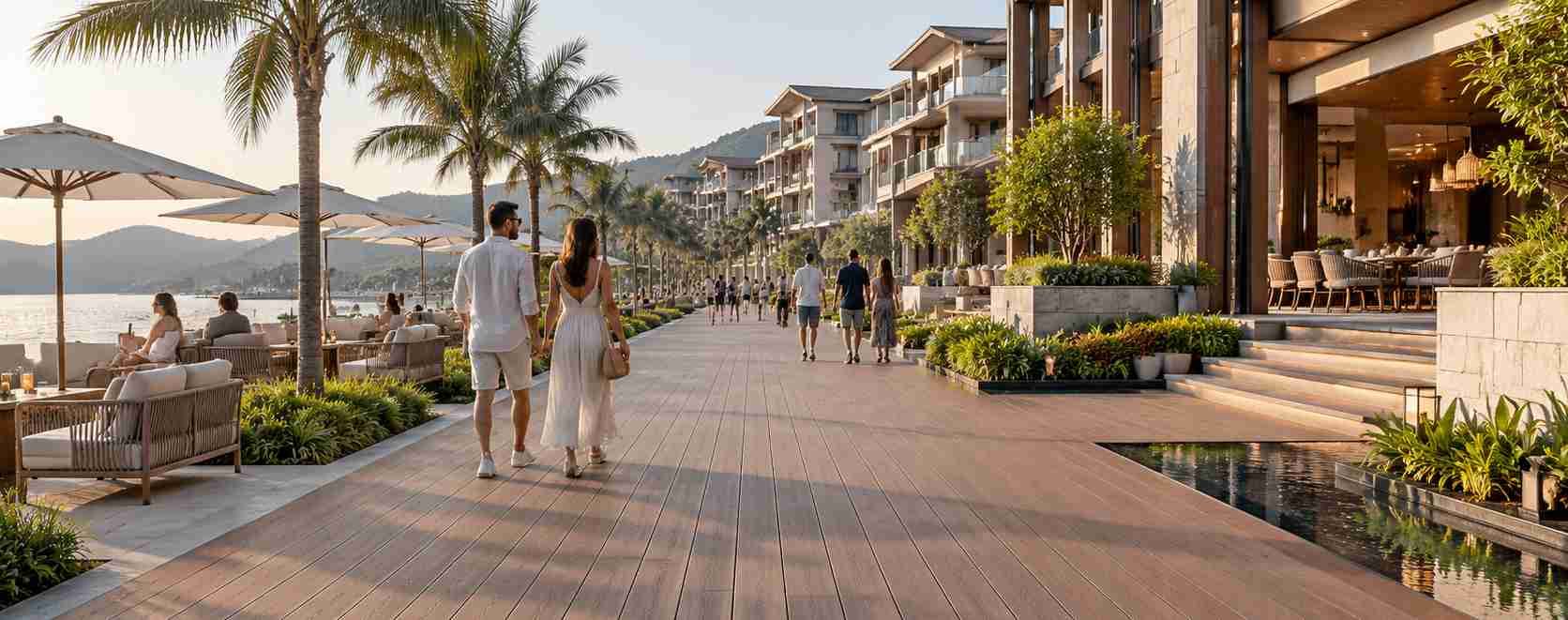
Commercial WPC decking should not be selected by appearance or price per square meter alone. A hotel terrace, public walkway, restaurant patio, resort platform, and commercial plaza can all use WPC decking, but they may require very different board structures, support spacing, surface performance, and weather resistance.
For contractors, architects, developers, and distributors, the more useful question is not “Which WPC decking is the strongest?” It is “What performance does this project actually require, and what product data proves that the board can meet it?”
This guide provides a practical specification method based on two variables that often determine long-term performance: traffic conditions and climate exposure. It also shows which technical information should be requested before approving a commercial decking product.
1. Quick Answer
For a commercial WPC decking project, specify the board in five steps:
- Define the traffic condition: normal pedestrian use, frequent commercial traffic, concentrated loads, carts, furniture, or maintenance equipment.
- Define the climate: hot and sunny, wet and humid, cold, coastal, or mixed seasonal conditions.
- Match the board structure to the load: review dimensions, profile geometry, density, flexural performance, and manufacturer span data.
- Match the surface to the environment: check wet slip performance, UV resistance, moisture resistance, drainage, and surface wear.
- Request measurable documentation: do not rely only on terms such as “commercial grade,” “heavy-duty,” or “weatherproof.”
A commercial decking specification is strongest when the board, substructure, climate, traffic, and installation method are considered as one system.
2. Key Takeaways
| Project Factor | What to Evaluate | Why It Matters |
|---|---|---|
| Traffic | Pedestrian frequency, concentrated loads, furniture and equipment | Determines structural and surface requirements |
| Board structure | Width, thickness, profile, density and weight per meter | Affects stiffness, span and handling |
| Climate | UV, rainfall, humidity, temperature variation and salt exposure | Influences dimensional stability and weathering |
| Surface safety | Texture, drainage and wet slip performance | Important for public and hospitality areas |
| Installation | Joist spacing, fastening, expansion gaps and ventilation | Directly affects actual performance after installation |
| Documentation | Test reports, span tables, specifications and warranty conditions | Allows suppliers to be compared on measurable criteria |
3. Start With Traffic, Not the Board Catalog
One of the most common purchasing mistakes is choosing a decking profile first and trying to make it fit the project later.
Commercial projects should work in the opposite direction. Start by identifying how the surface will be used.
| Application | Typical Traffic Condition | Main Specification Focus |
|---|---|---|
| Hotel terrace | Frequent pedestrian use, tables and chairs | Surface durability, appearance, load performance |
| Restaurant patio | Pedestrians, dining furniture and regular cleaning | Wear resistance, stain resistance, maintenance |
| Public walkway | Continuous pedestrian movement | Deflection, slip resistance, structural performance |
| Commercial plaza | Heavy pedestrian traffic and movable equipment | Load performance, surface durability and drainage |
| Resort platform | Pedestrians, furniture and outdoor activities | Weather resistance, comfort and appearance |
| Service or maintenance area | Potential carts, equipment or concentrated loads | Concentrated-load performance and support spacing |
Importantly, pedestrian traffic alone does not determine the required board. A relatively small number of heavy concentrated loads can be more demanding than a much larger number of ordinary foot movements.
For example, a restaurant terrace may have hundreds of guests moving across it every day, but the decking also has to support table legs, planters, service carts and occasional maintenance equipment. These loading conditions should be considered separately during specification.
4. Load Capacity Depends on More Than Board Strength
“Heavy-duty” is a useful marketing description, but it is not enough for engineering selection.
Commercial buyers should ask for measurable information covering the complete decking system. A board with high flexural strength can still perform poorly if it is installed over an unsuitable span or supported incorrectly.
| Technical Parameter | What to Request | Procurement Purpose |
|---|---|---|
| Board dimensions | Width × thickness × length | Confirms compatibility with the project design |
| Weight | kg/m or kg/m² | Useful for density comparison and logistics planning |
| Profile structure | Solid, hollow or engineered internal geometry | Helps assess stiffness, weight and span suitability |
| Flexural performance | Strength and/or modulus data | Useful for structural comparison |
| Allowable span | Manufacturer span table under stated loading | Determines substructure requirements |
| Fastener holding | Relevant test or technical data | Important for long-term fixing stability |
| Creep performance | Available creep or long-term loading data | Useful for commercial applications with repeated loading |
The key relationship is simple:
Board performance + support spacing + loading condition = actual installed performance.
This is why a supplier's span table is more useful than copying a generic joist spacing recommendation from another WPC product.
For projects with demanding outdoor conditions, Co-extruded Durable Waterproof WPC Decking can be included in the product comparison, but the final specification should still be based on the project's actual load, span and environmental requirements.
5. Climate Changes the Specification
The same WPC board can experience very different conditions depending on where it is installed. Climate should therefore be treated as a specification variable rather than a general product feature.
| Climate Condition | Primary Risk | Specification Check |
|---|---|---|
| Hot and sunny | UV exposure and thermal movement | UV performance, expansion allowance and dimensional stability |
| Wet and humid | Moisture retention and biological contamination | Water resistance, drainage and ventilation |
| Coastal | Salt spray, humidity and corrosion | Weather resistance and corrosion-resistant fasteners |
| Cold climate | Temperature cycling and freeze-thaw exposure | Dimensional stability and low-temperature performance |
| High-rainfall region | Persistent wet surfaces and drainage problems | Surface drainage, ventilation and wet slip performance |
| Mixed seasonal climate | Repeated expansion and contraction | Expansion gaps and installation-temperature requirements |
For climate-sensitive projects, do not ask only whether the product is “weather resistant.” Ask how that performance was evaluated.
Useful documentation can include accelerated UV testing, water absorption data, dimensional stability testing, freeze-thaw information where relevant, and other environmental test reports appropriate to the project.
A product such as WPC Co-extruded Outdoor Flooring may be suitable for applications where surface protection and outdoor weather exposure are important, but the buyer should compare the manufacturer's actual technical documentation with the site's climate rather than selecting the product based only on its product name.
6. Surface Safety Is a Separate Specification
Structural performance and walking safety should not be treated as the same thing.
A board can have sufficient structural capacity while still requiring additional evaluation for wet conditions. This is particularly important around pools, hotels, restaurants, public walkways and areas exposed to rainfall.
Before ordering, request:
- Slip-resistance test information for the actual surface finish.
- Details of the texture used on the production board.
- Drainage requirements below and between boards.
- Recommended cleaning procedures.
- Performance information for wet or frequently washed environments.
Also remember that slip performance belongs to the finished installation, not only the board. Water accumulation, dirt, algae, incorrect slope and poor drainage can change the walking condition after installation.
7. Do Not Ignore Thermal Movement
WPC contains thermoplastic material, so temperature changes can cause the boards to expand and contract. The effect becomes more important on large commercial installations, long board runs and projects exposed to strong temperature changes.
Before installation, confirm:
| Installation Item | Information to Confirm |
|---|---|
| End gaps | Required clearance based on board length and installation temperature |
| Side gaps | Recommended spacing between adjacent boards |
| Fixed structures | Clearance around walls, posts and drainage points |
| Long board runs | Movement allowance and joint strategy |
| Fastening system | Compatibility with the selected board and expected movement |
Longer boards can reduce the number of visible joints and material cuts, but they also make thermal movement more important. The installation temperature should therefore be recorded before the contractor begins fixing the decking.
8. A Practical Specification Decision Chart
| Project Condition | First Question | Next Specification Step |
|---|---|---|
| High pedestrian traffic | What is the expected loading? | Review load data, profile and span table |
| Heavy furniture or equipment | Are concentrated loads expected? | Check concentrated-load requirements and support spacing |
| Hot climate | What temperature range will the deck experience? | Review UV, dimensional stability and expansion requirements |
| Wet climate | Can water drain and evaporate quickly? | Review drainage, ventilation and wet slip performance |
| Coastal location | Will salt spray reach the deck and hardware? | Review environmental resistance and fastener material |
| Large commercial project | Can the supplier provide consistent technical data? | Request test reports, samples and batch-control information |
9. Real-World Procurement Lesson: Specify the System, Not Just the Board
In commercial projects, many problems that appear to be “decking quality issues” actually originate from a mismatch between the board and the project conditions.
For example, consider a resort walkway in a hot, humid region. Selecting a board only because it has an attractive wood texture does not answer the important engineering questions. The project team still needs to consider pedestrian loading, wet slip performance, UV exposure, drainage, thermal movement, fastening, cleaning and replacement requirements.
Similarly, a commercial plaza in a dry climate may have less moisture exposure but significantly higher pedestrian traffic and more outdoor furniture. In that case, structural performance and surface wear may deserve greater attention than marine resistance.
This is why a good commercial specification does not simply say “premium WPC decking.” It identifies the actual operating conditions and connects them to measurable product requirements.
For a project requiring strong outdoor weather resistance, co-extruded weather-resistant WPC flooring can be evaluated alongside alternative profiles according to the same technical checklist.
10. What Should Be Included in a Commercial WPC Specification Sheet?
Before approving a supplier, procurement teams should ideally have one technical document containing the following information:
| Specification Category | Recommended Information |
|---|---|
| Product identification | Model, profile drawing, dimensions and available lengths |
| Material | Core material, polymer type and surface construction |
| Mechanical | Flexural data, allowable load and span recommendations |
| Environmental | Water, UV, temperature and relevant weathering data |
| Surface | Texture, wear characteristics and slip-resistance information |
| Installation | Joist spacing, clips, fasteners and expansion requirements |
| Quality control | Relevant test reports, inspection procedures and batch consistency |
| Commercial supply | MOQ, production capacity, lead time, packaging and customized lengths |
| Warranty | Coverage, environmental limitations and installation conditions |
This document also makes supplier comparison much easier. Instead of comparing three quotations based on price per square meter, the project team can compare the same technical fields across all three suppliers.
11. FAQ: Commercial WPC Decking
Is commercial WPC decking different from residential WPC decking?
It can be. The difference is not necessarily the material name. Commercial projects typically require more detailed evaluation of traffic, loading, support spacing, surface wear, slip resistance, maintenance and environmental exposure.
How do I know which WPC profile is suitable for a commercial project?
Start with the required span and loading rather than choosing solid or hollow construction simply by appearance. Compare the profile drawing, dimensions, weight, mechanical data and manufacturer's span recommendations.
Does co-extrusion automatically make a board suitable for commercial use?
No. Co-extrusion can provide a protective outer layer, but overall performance also depends on the core formulation, profile geometry, board dimensions, substructure, fastening system and installation method.
What climate information should I give a WPC supplier?
Provide the project location and describe temperature variation, rainfall, humidity, direct sunlight, coastal exposure and freeze-thaw conditions where applicable. This gives the supplier enough information to recommend a relevant product specification.
What technical documents should I request before bulk ordering?
Request a product data sheet, profile drawing, mechanical test information, environmental performance data, span recommendations, installation instructions, fastening specifications, warranty conditions and samples from the intended production batch where practical.
Should price per square meter be the main purchasing factor?
No. For commercial projects, compare the complete installed system. A lower board price can be offset by additional support requirements, higher installation labor, more frequent maintenance, greater material waste or unsuitable performance in the project environment.
What is the most important question to ask before approving a WPC decking product?
Ask the supplier to show how the proposed board specification matches the project's actual traffic, span, climate and installation conditions. If those four elements cannot be connected with technical documentation, the product should not be approved based on marketing claims alone.
- How to Calculate WPC Decking Quantities for Large Projects: Board Coverage, Waste and Accessories
- WPC Decking for Rooftop Terraces: Load Planning, Drainage and Waterproofing Risks
- What Technical Documents Should You Request from a WPC Wall Cladding Manufacturer?
- How to Maintain WPC Wall Cladding Color Consistency in Large Projects
- How to Calculate WPC Wall Cladding Quantities: Panel Coverage, Cutting Waste and Accessories
- WPC Exterior Wall Cladding for Building Renovation: How to Check Substrates, Fixings and Ventilation
- WPC Decking for Hotels and Resorts: How to Choose Materials for Outdoor Areas
- WPC Decking for Commercial Projects: How to Specify Boards for Traffic and Climate