

WPC Decking Lifecycle Cost Analysis: Initial Price, Installation, Maintenance and Long-Term Value


Author
With years of experience in exterior building materials, I specialize in advanced wood-plastic composite (WPC) technologies. My goal is to help architects, contractors, and project managers navigate the complexities of modern decking solutions. By bridging the gap between structural engineering and sustainable design, I share practical insights to ensure your outdoor projects achieve maximum durability and the best possible ROI.
Alex Carter


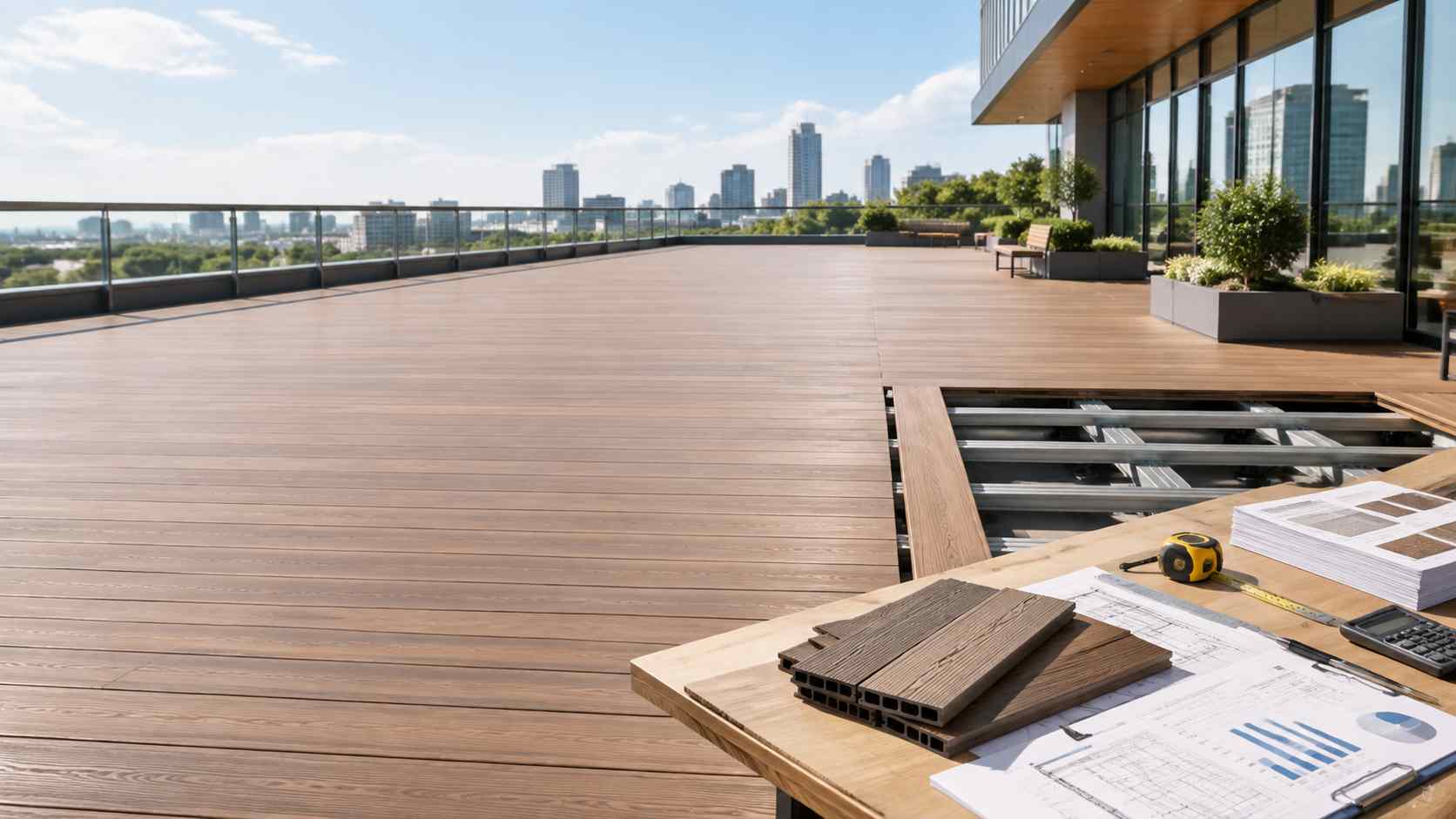
When comparing WPC decking suppliers, the lowest price per square meter does not necessarily represent the lowest project cost. For commercial terraces, hospitality developments, residential communities, public spaces and other large outdoor projects, the actual financial impact extends beyond the decking boards themselves. Installation, substructure, fasteners, cutting waste, transportation, maintenance and future replacement can materially change the total cost of ownership.
This article evaluates WPC decking from a lifecycle cost perspective rather than comparing board prices alone. The objective is to provide procurement teams, contractors, distributors and project owners with a practical framework for comparing different WPC decking solutions before placing a bulk order.
1. Research Scope and Methodology
The analysis uses a project-level lifecycle cost framework covering six major cost categories: decking materials, substructure, installation, logistics, maintenance and replacement. The evaluation considers the initial procurement stage and subsequent ownership stages over a multi-year project period.
This financial lifecycle model should be distinguished from environmental Life Cycle Assessment (LCA). LCA evaluates environmental impacts across a product's life cycle, while lifecycle cost analysis evaluates the economic resources required to purchase, install, maintain and replace the product.
Published WPC research is used to explain why durability, raw materials, manufacturing processes, transportation and end-of-life treatment can influence long-term performance. However, no universal market price is assumed because WPC costs vary significantly according to profile design, polymer type, surface treatment, quantity, supplier location, shipping distance and project requirements. [1] [2]
2. What Actually Determines the Lifecycle Cost of WPC Decking?
| Cost Category | Typical Cost Drivers | Procurement Risk |
|---|---|---|
| Decking Material | Profile, dimensions, material formulation, surface technology, quantity | Low to High |
| Substructure | Joists, spacing, supports, fixing method | Medium |
| Installation | Labor, cutting, fastening, site conditions and layout complexity | Medium to High |
| Logistics | Container utilization, shipment distance, packaging and handling | Medium |
| Maintenance | Cleaning, surface care, repairs and replacement components | Low to Medium |
| Replacement | Product durability, local damage, refurbishment requirements | High |
A practical lifecycle cost equation can therefore be written as:
Total Lifecycle Cost = Material + Substructure + Installation + Logistics + Maintenance + Replacement − Residual Value
This equation is particularly useful for B2B procurement because two products with similar board prices can produce substantially different installed costs.
3. Initial WPC Decking Price Is Only the First Variable
The first quotation received from a supplier normally focuses on the decking board itself. However, the quoted price may not represent the complete material package required for installation.
For example, a project may require decking boards, joists, clips, screws, starter clips, end clips, edge profiles and other accessories. If these components are purchased separately, the apparent advantage of a lower board price can disappear after the complete installation system is calculated.
For projects exposed to strong sunlight, rainfall, humidity or frequent pedestrian traffic, surface structure and material formulation should also be considered. A product designed for demanding outdoor applications may have a different upfront price but can offer a different maintenance and replacement profile.
For example, buyers evaluating long-term outdoor applications can compare Weather-Resistant Co-Extrusion WPC Decking against conventional profiles by examining the complete specification rather than price alone.
4. Installation Cost Can Change the Project Calculation
Installation is one of the most frequently underestimated elements in decking procurement. The number of boards required is not determined simply by dividing the deck area by the nominal board coverage.
A practical calculation is:
Required Material = Net Deck Area + Cutting Allowance + Layout Allowance + Replacement Allowance
Board length, installation direction, deck geometry and the location of joints can all affect material consumption. Rectangular projects with simple layouts generally generate less cutting waste than projects containing curves, corners, steps and multiple elevations.
| Installation Component | Why It Matters |
|---|---|
| Decking Boards | Determines primary material consumption and cutting waste |
| Fasteners | Influences installation speed and connection reliability |
| Substructure | Determines support spacing and structural installation requirements |
| Edge Finishing | Adds material and labor around exposed deck edges |
| Labor | Affected by board length, fastening system, site conditions and layout |
For projects where installation efficiency is important, the decking system should therefore be evaluated as a complete package. 3D Embossed WPC Decking Boards can be evaluated not only for surface appearance but also for board dimensions, installation configuration and project-specific material requirements.
5. Maintenance and Durability Affect Long-Term Cost
Maintenance is difficult to estimate using a single universal number because actual requirements depend on climate, exposure, traffic, drainage and cleaning practices.
Research on WPC aging shows that outdoor exposure can affect mechanical properties, with ultraviolet radiation and environmental conditions playing important roles in material aging. [3]
This is important for lifecycle cost analysis because a product that requires more frequent repair or replacement can create additional labor and material costs even if its initial purchase price is attractive.
| Project Stage | Cost Items to Monitor | Procurement Question |
|---|---|---|
| Year 0 | Material, accessories, shipping, installation | What is the complete installed cost? |
| Years 1–5 | Cleaning, minor repairs, replacement accessories | What routine maintenance is expected? |
| Years 5–10 | Surface condition, damaged boards, local repairs | What components may require replacement? |
| Years 10–20 | Major repairs or partial replacement | What is the expected refurbishment strategy? |
The key point is that a supplier's warranty period should not automatically be treated as the product's universal service life. Service life depends on product formulation, installation, environment, loading and maintenance conditions.
6. Transportation Can Become a Major B2B Cost Variable
For international procurement, transportation should be included in the lifecycle calculation from the beginning. WPC decking is relatively bulky, which makes container utilization and loading efficiency important for large orders.
The effective landed cost can be expressed as:
Landed Cost = Product Cost + Packaging + Inland Freight + Ocean Freight + Insurance + Import Charges + Local Delivery
Longer boards can sometimes reduce the number of joints required on a project, but they can also influence container loading, handling and transportation efficiency. Therefore, the optimal board length should be determined according to both installation requirements and logistics.
A 2025 industrial LCA of WPC decking manufacturing found that long-distance maritime transportation could increase certain environmental impact indicators, demonstrating that transportation distance and logistics should not be treated as insignificant variables in lifecycle assessments. [1]
7. A Practical Lifecycle Cost Model for B2B Procurement
A procurement team can compare suppliers using the following structure instead of comparing the quoted decking price alone.
| Evaluation Item | Supplier A | Supplier B | Supplier C |
|---|---|---|---|
| Decking Unit Price | Record quotation | Record quotation | Record quotation |
| Accessories | Included / Extra | Included / Extra | Included / Extra |
| Substructure Cost | Project estimate | Project estimate | Project estimate |
| Installation Cost | Labor estimate | Labor estimate | Labor estimate |
| Landed Cost | Calculate | Calculate | Calculate |
| Maintenance Requirement | Supplier data | Supplier data | Supplier data |
| Warranty | Record warranty | Record warranty | Record warranty |
| Replacement Assumption | Project estimate | Project estimate | Project estimate |
This approach turns supplier comparison into a measurable procurement exercise. Instead of asking only “Which supplier has the lowest price?”, the more useful question is “Which system provides the lowest total project cost under the same performance requirements?”
8. Why Material Composition and Manufacturing Process Matter
WPC is not a single standardized material formulation. Different products can use different polymers, wood fibers, additives, recycled materials and processing conditions. Consequently, two products marketed simply as “WPC decking” may have significantly different performance characteristics.
A 2017 LCA study found that the environmental performance of WPC can be strongly affected by the choice of raw materials and end-of-life pathway, while the use of secondary materials can improve performance under the study's defined conditions. [2]
More recent research has also emphasized the importance of using primary industrial data when evaluating recycled-material WPC production. A 2025 study based on data from Australian recycling businesses reported that previous assessments could underestimate climate impacts when production processes and allocation factors are incomplete. [4]
For B2B buyers, this means that supplier documentation should include more than a product catalog. Material composition, recycled content, profile structure, production process, testing data and quality-control procedures can all help explain differences between quotations.
9. Lifecycle Cost Should Be Compared With the Complete Decking System
For large projects, a decking board should not be evaluated as an isolated commodity. The complete system includes the board, support structure, fastening method, edge treatment, packaging, transportation and installation requirements.
For example, buyers sourcing Wholesale Co-Extrusion WPC Decking Boards should request sufficient technical information to calculate the complete installed cost before comparing suppliers.
| Procurement Stage | Recommended Action |
|---|---|
| Stage 1: Product Screening | Compare profile, dimensions, formulation, surface and technical specifications |
| Stage 2: Cost Calculation | Calculate material, accessories, substructure, installation and logistics |
| Stage 3: Performance Review | Review water exposure, UV resistance, mechanical properties, testing and warranty |
| Stage 4: Supplier Comparison | Compare total landed and installed cost rather than board price alone |
10. What Published Research Tells Procurement Teams
The academic literature does not support a simple statement that one decking material is always the lowest-cost or lowest-impact option. Results depend on the functional unit, service-life assumptions, raw materials, manufacturing process, maintenance scenario, transportation and end-of-life treatment. [2] [5]
A 2011 cradle-to-grave comparison between ACQ-treated lumber and WPC decking, for example, reported different environmental impacts under its defined assumptions. The authors also noted that WPC products vary substantially in formulations and manufacturing processes, which is an important limitation when generalizing results across products. [5]
A 2025 study specifically focused on WPC decking manufacturing in China and found that raw material acquisition, premixing, pelletizing and co-extrusion were major contributors to environmental impacts. The same study reported that changing the electricity source to solar reduced global warming potential by 38.9% within its modeled production case. [1]
These findings do not provide a universal price or environmental score for every WPC decking product. Instead, they reinforce the value of product-specific procurement data and transparent lifecycle assumptions.
11. Data Limitations and How to Use This Model
This lifecycle cost framework is intended for supplier comparison and project planning rather than as a substitute for a project-specific quantity survey. Actual costs depend on the destination market, project geometry, labor rates, local building requirements, shipping terms, exchange rates and supplier quotation.
For a more accurate calculation, procurement teams should request the following information from each supplier:
- Decking price per square meter or linear meter
- Board dimensions and weight
- Coverage per board
- Recommended joist spacing
- Fastener and accessory requirements
- Packaging quantity and container loading information
- Warranty conditions
- Testing and performance documentation
- Recommended cleaning and maintenance procedures
- Replacement board availability
Once these variables are available, the lifecycle model can be converted into a project-specific cost comparison using the same assumptions for every supplier.
12. References
- Cui, H., Zheng, Y., Wang, Z., et al. (2025). Life cycle assessment of wood plastic decking manufacturing: Reduction of environmental impacts based on an industrial case study in China . Environmental Research, 287, 123147. ↩
- Sommerhuber, P. F., Wenker, J. L., Rüter, S., & Krause, A. (2017). Life cycle assessment of wood-plastic composites: Analysing alternative materials and identifying an environmental sound end-of-life option . Resources, Conservation and Recycling, 117, 235–248. ↩
- Investigations on ageing of wood-plastic composites for outdoor applications: A meta-analysis using empiric data derived from diverse weathering trials. (2016). Construction and Building Materials, 124, 1142–1152 . ↩
- Converting plastic waste into wood-plastic composite products – A practical environmental impacts assessment using primary data. (2025). Resources, Conservation and Recycling, 218, 108267 . ↩
- Bolin, C. A., & Smith, S. T. (2011). Life cycle assessment of ACQ-treated lumber with comparison to wood plastic composite decking . Journal of Cleaner Production, 19(6–7), 620–629. ↩
- Wood polymer composites and their contribution to cascading utilisation. (2016). Journal of Cleaner Production . ↩
- Implementing Ecodesign During Product Development: An Ex-Ante Life Cycle Assessment of Wood-Plastic Composites. (2023). Springer . ↩
- Marine WPC Decking: How Co-Extrusion Improves Performance in Coastal and Waterfront Applications
- Heavy-Duty WPC Decking for Walkways: Co-Extrusion, Load Capacity and Marine Applications
- How Fluted WPC Wall Cladding Elevates Commercial and Residential Exteriors
- Why WPC is the Best Material for Coastal Homes and Poolside Decks?
- WPC Decking Lifecycle Cost Analysis: Initial Price, Installation, Maintenance and Long-Term Value
- How to Install WPC Decking for Outdoor Projects: Step-by-Step Guide
- WPC Wall Panels for Interior & Exterior Projects: Types, Benefits, Applications & Buying Guide
- Co-Extrusion WPC Decking: Benefits, Performance, Cost & B2B Buying Guide