

How to Choose WPC Decking for Tropical Climates: Water Absorption, Slip Resistance and Long-Term Performance Analysis


Author
With years of experience in exterior building materials, I specialize in advanced wood-plastic composite (WPC) technologies. My goal is to help architects, contractors, and project managers navigate the complexities of modern decking solutions. By bridging the gap between structural engineering and sustainable design, I share practical insights to ensure your outdoor projects achieve maximum durability and the best possible ROI.
Alex Carter


Outdoor decking projects in tropical regions require a higher level of material performance than standard residential applications. Countries across Southeast Asia, including Indonesia, Malaysia, Thailand, and the Philippines, experience high humidity, heavy rainfall, intense sunlight, and frequent temperature changes throughout the year. These environmental conditions create continuous pressure on outdoor flooring systems.
For commercial projects such as resorts, hotels, public walkways, swimming pool areas, and landscape developments, choosing decking only based on appearance can create long-term maintenance problems. Professional buyers need to evaluate measurable technical indicators including water absorption, wet slip resistance, flexural strength, and screw withdrawal strength before making purchasing decisions.
Advanced Commercial WPC Decking For Tropical Projects is developed to solve these challenges by combining wood appearance with composite material stability. However, not all WPC decking products perform the same. Understanding the testing data behind the product helps architects, contractors, and distributors select a solution suitable for demanding outdoor environments.
Why Tropical Climate Conditions Are Challenging for Outdoor Decking
Tropical climates create a combination of environmental factors that accelerate material aging. Unlike dry regions where moisture exposure is limited, tropical outdoor flooring experiences repeated wet and dry cycles every season.
| Climate Factor | Impact on Outdoor Flooring | Potential Risk |
|---|---|---|
| High Humidity (70%-90% RH) | Continuous moisture exposure | Swelling, mold growth, surface damage |
| Heavy Rainfall | Repeated water penetration | Material expansion and deformation |
| Strong UV Exposure | Surface oxidation | Color fading and aging |
| Temperature Cycling | Repeated expansion and contraction | Cracking and installation movement |
Traditional wood decking is especially vulnerable in these environments because wood naturally absorbs moisture through its cellular structure. When moisture enters the material, the fibers expand. After drying, they shrink again. This repeated movement gradually weakens the structure.
In tropical resort projects, this problem becomes more serious because decking areas are usually exposed to daily foot traffic, pool water, cleaning chemicals, and outdoor weather conditions.
Water Absorption: The Most Important Performance Indicator for Tropical Decking
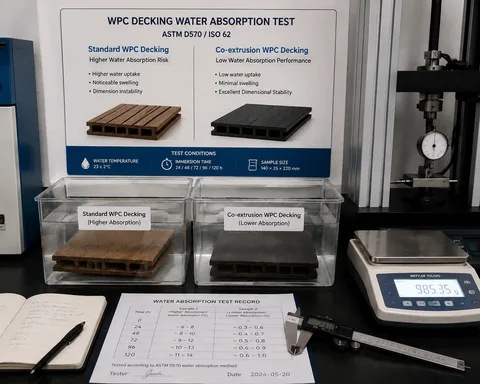
Water absorption percentage is one of the first technical specifications buyers should review when selecting outdoor decking materials. It directly affects dimensional stability, service life, and maintenance requirements.
When decking absorbs excessive water, several problems may occur:
- Board expansion after rainfall
- Edge deformation and uneven surfaces
- Reduced screw fastening stability
- Internal moisture retention and biological growth
High-performance Co Extrusion Composite Decking For Resorts uses a protective outer polymer layer that surrounds the composite core. This structure reduces direct water contact and improves resistance against moisture penetration.
| Test Item | Typical Testing Method | Performance Target | Engineering Meaning |
|---|---|---|---|
| Water Absorption | 24-hour water immersion test | ≤0.5% | Lower moisture penetration and better stability |
| Thickness Expansion | Water exposure measurement | Low expansion rate | Maintains installation accuracy |
| Surface Protection | Co-extrusion layer evaluation | Continuous protective layer | Reduces staining and moisture damage |
For large commercial projects, a lower water absorption rate means fewer repair requirements after installation. This is especially valuable for hotels, resorts, and public facilities where replacing damaged decking can interrupt normal operations.
Wet Slip Resistance: A Critical Safety Requirement for Outdoor Projects
In tropical climates, rainfall is not an occasional event. Outdoor surfaces can remain wet for hours after heavy rain, especially in shaded areas, pool surroundings, gardens, and public walkways. For this reason, slip resistance is a key specification that should be evaluated before purchasing decking materials.
Many buyers focus on color, wood grain appearance, and price, but surface safety directly affects project reputation and operational risk. A slippery deck around a swimming pool or hotel pathway can increase the possibility of accidents and create unnecessary liability concerns.
Professional-grade WPC decking uses surface embossing technology and optimized textures to improve friction performance. Deep wood grain patterns create additional contact points between footwear and the decking surface, helping maintain traction under wet conditions.
| Surface Type | Wet Condition Performance | Suitable Applications |
|---|---|---|
| Smooth Outdoor Flooring | Friction decreases significantly after rainfall | Limited outdoor use |
| Traditional Wood Decking | Performance depends on maintenance condition | Residential applications |
| Embossed WPC Decking | Stable grip performance after wet exposure | Pools, resorts, walkways, commercial landscapes |
When evaluating Low Maintenance Outdoor Decking Material, buyers should request wet-condition testing data instead of relying only on visual inspection. A realistic evaluation should include surface texture, drainage design, and slip resistance after long-term outdoor exposure.
Mechanical Performance: Why Flexural Strength and Screw Withdrawal Strength Matter
Weather resistance is only one part of decking performance. A high-quality outdoor flooring system must also maintain structural strength after years of loading, temperature changes, and moisture exposure.
Two important mechanical indicators for professional decking projects are flexural strength and screw withdrawal strength.
Flexural Strength: Preventing Bending and Structural Deformation
Flexural strength measures how much bending force a decking board can withstand before permanent deformation occurs. This value is important because outdoor decking is continuously exposed to dynamic loads, including pedestrian traffic, furniture weight, and temperature-related movement.
For commercial projects with large installation areas, insufficient flexural strength may result in:
- Uneven walking surfaces
- Board sagging between joists
- Cracking caused by repeated stress
- Higher replacement costs
Screw Withdrawal Strength: Maintaining Long-Term Fastening Stability
Screw withdrawal strength measures how effectively screws remain fixed inside the decking material. This property is especially important because most outdoor decking systems rely on hidden clips or screws connected to a substructure.
In humid regions, repeated expansion and contraction can gradually weaken fastening points. Strong screw holding performance helps maintain a stable connection between decking boards and the supporting frame.
| Mechanical Test | Purpose | Project Benefit |
|---|---|---|
| Flexural Strength Test | Evaluates bending resistance under load | Reduces deformation during long-term use |
| Screw Withdrawal Test | Measures fastening reliability | Improves installation safety and durability |
| Impact Resistance Test | Evaluates surface damage resistance | Suitable for high traffic areas |
Life Cycle Cost Comparison: Why Technical Performance Reduces Project Expenses
For commercial buyers, the initial purchase price is only one part of the total investment. Maintenance frequency, repair requirements, labor costs, and replacement cycles have a significant impact on the total project cost.
| Cost Factor | Traditional Wood Decking | Co-extrusion WPC Decking |
|---|---|---|
| Initial Installation | Lower material cost in some regions | Higher material value with engineered performance |
| Annual Maintenance | Requires sealing, coating, and inspection | Minimal cleaning requirements |
| Moisture Damage Risk | Higher risk in tropical areas | Lower absorption and better stability |
| Long-Term Value | Higher maintenance expense | Lower lifecycle cost |
Tropical Project WPC Decking Specification Checklist
Before placing a bulk order for outdoor decking, project buyers should review the following technical information with the supplier:
| Specification | Why It Matters |
|---|---|
| Water Absorption (%) | Shows moisture resistance and dimensional stability |
| Wet Slip Resistance | Ensures safer outdoor usage after rainfall |
| Flexural Strength | Confirms structural reliability under load |
| Screw Withdrawal Strength | Ensures stable installation performance |
| UV Resistance Test | Helps maintain appearance under sunlight exposure |
| Installation Guide | Reduces construction errors and future issues |
- How to Calculate WPC Decking Quantities for Large Projects: Board Coverage, Waste and Accessories
- WPC Decking for Rooftop Terraces: Load Planning, Drainage and Waterproofing Risks
- What Technical Documents Should You Request from a WPC Wall Cladding Manufacturer?
- How to Maintain WPC Wall Cladding Color Consistency in Large Projects
- How to Calculate WPC Wall Cladding Quantities: Panel Coverage, Cutting Waste and Accessories
- WPC Exterior Wall Cladding for Building Renovation: How to Check Substrates, Fixings and Ventilation
- WPC Decking for Hotels and Resorts: How to Choose Materials for Outdoor Areas
- WPC Decking for Commercial Projects: How to Specify Boards for Traffic and Climate