

The Economic and Structural Advantages of WPC Fencing Installations


Author
With years of experience in exterior building materials, I specialize in advanced wood-plastic composite (WPC) technologies. My goal is to help architects, contractors, and project managers navigate the complexities of modern decking solutions. By bridging the gap between structural engineering and sustainable design, I share practical insights to ensure your outdoor projects achieve maximum durability and the best possible ROI.
Alex Carter


When evaluating materials for large-scale perimeter fencing, property developers and commercial contractors often face a critical dilemma: balancing upfront material procurement costs against long-term structural reliability and ongoing maintenance expenses. For decades, the construction industry has relied on treated pine or cedar, accepting high installation labor and inevitable rot as the unavoidable costs of doing business. However, in today's demanding economic climate, minimizing on-site labor hours and eliminating operational expenditure (OPEX) have become paramount to project profitability.
This shift in procurement strategy has dramatically accelerated the adoption of advanced composite materials in the perimeter security and landscaping sectors. By transitioning away from archaic timber construction and specifying Commercial Grade WPC Privacy Fence products, contractors can drastically streamline their installation processes, mitigate catastrophic post-installation failures, and deliver an unmatched return on investment (ROI) for property owners.
Solving the Labor Crisis: Engineered for Assembly
The largest variable cost in any commercial fencing project is skilled labor. Traditional wooden fences require extensive on-site fabrication. Carpenters must manually measure, cut, align, level, and face-nail hundreds of individual pickets or boards. Furthermore, the inherent imperfections in natural wood—such as bowing, crowning, and severe knots—force crews to waste valuable time sorting lumber and troubleshooting warped pieces on the job site. Once erected, the entire massive structure must then be manually painted or chemically stained, doubling the time the crew spends on the property.
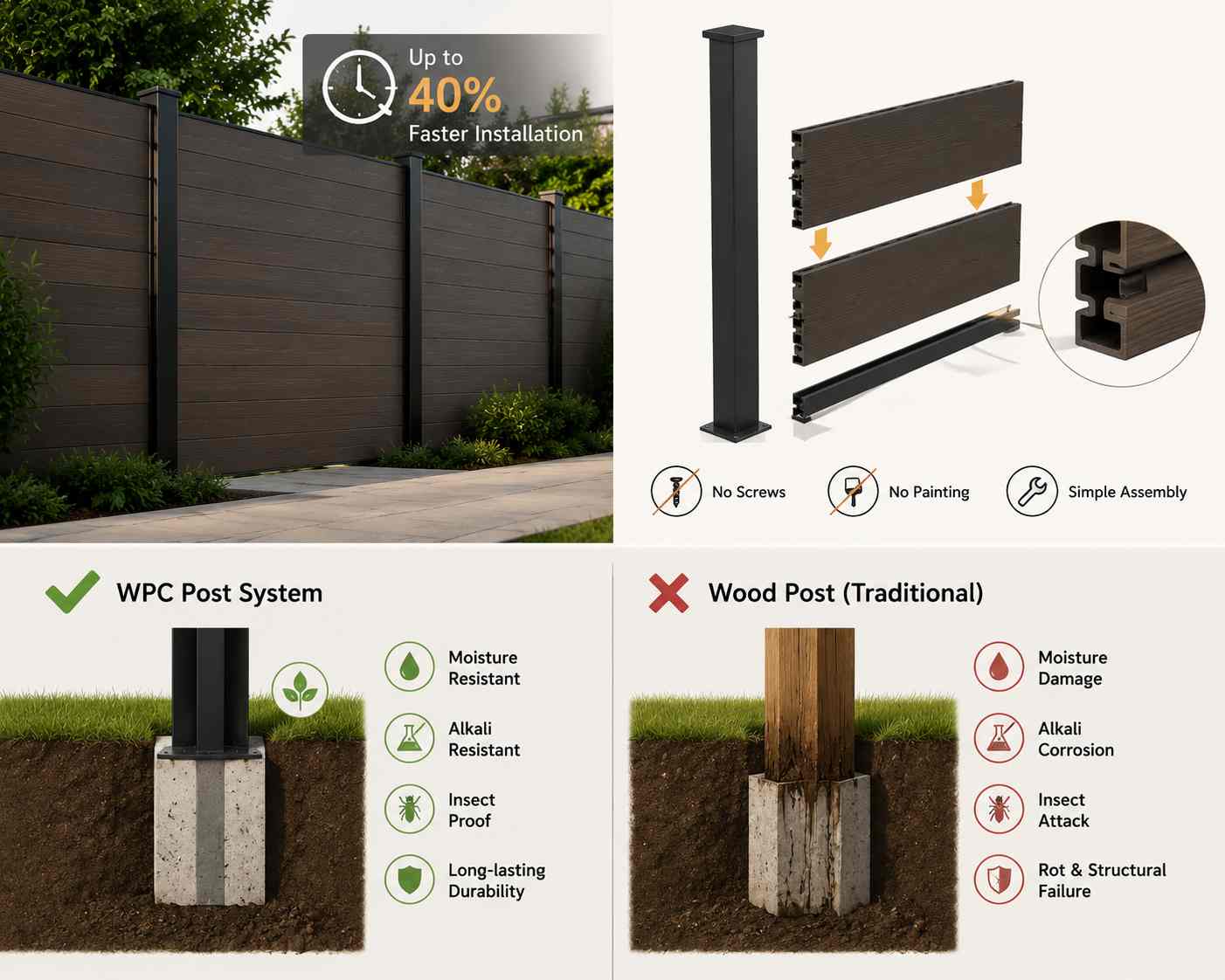
WPC fencing fundamentally transforms construction into a rapid assembly process. High-quality Heavy Duty WPC Fence Boards are manufactured via precision extrusion, ensuring every single piece is dimensionally identical, perfectly straight, and flawlessly finished right out of the factory crate. Many commercial composite designs utilize an ingenious tongue-and-groove interlocking profile. Installers simply secure the posts, slide the bottom rail into place, and seamlessly stack the interlocking boards vertically or horizontally. This modular engineering eliminates the need for thousands of individual screws, completely removes the painting phase, and typically reduces total on-site labor hours by up to 40% compared to traditional stick-built timber fences.
Conquering Ground Contact and Soil Alkalinity
From an engineering standpoint, the most vulnerable point of any fence is where the post meets the soil. Ground-contact wood is subjected to continuous attacks from soil moisture, highly alkaline or acidic fertilizers, and relentless subterranean insects. Even pressure-treated lumber will eventually succumb to fungal rot at the concrete footing interface, causing the entire fence line to lean or collapse during the first severe windstorm.
WPC products possess an inherent molecular resistance to biological decay. The dense polymer shield encapsulating the recycled hardwood fibers is completely impervious to soil moisture, chemical fertilizers, and termite digestion. When WPC posts are anchored into concrete footings or attached to galvanized steel ground spikes, they do not rot, rust, or degrade. This absolute immunity to ground-level environmental stress guarantees that the structural foundation of the fence remains as rigid and secure in year twenty as it was on the day of installation.
Structural Rigidity and Deflection Resistance
A privacy fence must withstand immense lateral wind loads without permanent deflection (bending). Thin vinyl (PVC) fencing is notoriously brittle; in freezing temperatures, a minor impact from a landscaping mower or a heavy wind gust can shatter the plastic panels completely. Conversely, aging timber becomes weak and snaps under sudden kinetic stress.
The superior solution lies in the material density of the perimeter barrier. Specifying High Density WPC Fencing Panels provides exceptional flexural strength. The heavily compressed thermoplastic matrix absorbs blunt impacts without bruising, while the thick, multi-chambered extrusion profiles offer massive resistance against wind shear. For ultra-commercial applications, these heavy-duty WPC panels are often reinforced with concealed aluminum inserts, creating an impenetrable structural barrier that easily meets and exceeds stringent local wind load building codes.
The 20-Year Lifecycle Cost Analysis (ROI)
To understand the true economic advantage of WPC, developers must look beyond the initial purchase order and calculate the Total Cost of Ownership (TCO) over a standard 20-year property lifecycle. While traditional timber presents a lower initial material cost, it triggers a catastrophic chain of recurring maintenance expenses.
A wooden fence requires professional chemical cleaning, sanding, and re-staining every two to three years to prevent structural decay. By year seven, warped boards and rotting posts typically require costly partial replacements. In stark contrast, a WPC fence demands zero operational expenditure. There are no paints to buy, no sealant contractors to hire, and no rotting posts to replace. Financial modeling consistently demonstrates that the total cost of a timber fence surpasses the cost of a premium WPC fence between years four and five. From that point onward, the WPC fence generates pure financial savings for the property owner.
| Project Variable | Traditional Timber Fence | Premium WPC Fencing |
|---|---|---|
| Installation Labor | Extremely high. Requires measuring, face-nailing, leveling warped boards, and painting. | Significantly reduced. Modular tongue-and-groove assembly requires no nailing or painting. |
| Ground Contact Survivability | Poor. Even treated posts eventually succumb to soil moisture rot and termite damage. | Absolute immunity. Polymer matrix cannot rot or be digested by any biological pest. |
| Impact & Wind Resistance | Moderate initially, but degrades rapidly as the wood dries out and becomes brittle. | Extremely high. Thick extrusions absorb impact; aluminum cores safely deflect wind shear. |
| 20-Year Maintenance Cost | Massive. Requires continuous reinvestment in stains, sealants, and replacement labor. | Zero. Requires only periodic washing with water to maintain a pristine aesthetic. |
Engineering a Profitable Perimeter
In commercial and high-end residential landscaping, relying on archaic, high-maintenance materials is a rapid path to compromised profit margins and unhappy clients. Wood-Plastic Composite fencing represents the pinnacle of exterior material engineering, perfectly aligning architectural beauty with strict economic logic. By eliminating the grueling labor of traditional carpentry, entirely eradicating the threat of ground rot, and reducing lifecycle maintenance costs to zero, WPC stands as the single most intelligent, secure, and profitable investment for any modern perimeter project.
- How to Calculate WPC Decking Quantities for Large Projects: Board Coverage, Waste and Accessories
- WPC Decking for Rooftop Terraces: Load Planning, Drainage and Waterproofing Risks
- What Technical Documents Should You Request from a WPC Wall Cladding Manufacturer?
- How to Maintain WPC Wall Cladding Color Consistency in Large Projects
- How to Calculate WPC Wall Cladding Quantities: Panel Coverage, Cutting Waste and Accessories
- WPC Exterior Wall Cladding for Building Renovation: How to Check Substrates, Fixings and Ventilation
- WPC Decking for Hotels and Resorts: How to Choose Materials for Outdoor Areas
- WPC Decking for Commercial Projects: How to Specify Boards for Traffic and Climate