

Why Is WPC Wall Cladding Becoming Popular in Modern Commercial Façade Design?

Author
With years of experience in exterior building materials, I specialize in advanced wood-plastic composite (WPC) technologies. My goal is to help architects, contractors, and project managers navigate the complexities of modern decking solutions. By bridging the gap between structural engineering and sustainable design, I share practical insights to ensure your outdoor projects achieve maximum durability and the best possible ROI.
Alex Carter


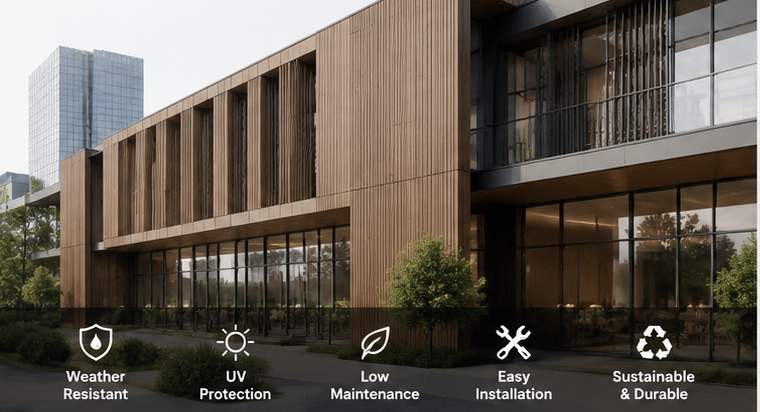
Wood Plastic Composite (WPC) wall cladding has become an increasingly important material in modern commercial façade engineering. It is widely used in architectural projects that require a balance between durability, aesthetic flexibility, and long-term cost efficiency. As building design shifts toward sustainable and low-maintenance exterior systems, Commercial Exterior WPC Wall Cladding materials are replacing traditional timber and metal cladding in many mid- to large-scale developments.
Unlike conventional façade materials, WPC systems combine natural wood fibers with polymer resins, creating a composite structure that improves resistance to environmental exposure while maintaining a wood-like appearance. This hybrid material approach makes WPC particularly suitable for ventilated façade systems, commercial buildings, and architectural cladding applications.
1. Material Composition and Manufacturing Technology
WPC (Wood Plastic Composite) is manufactured by combining finely processed wood fibers with thermoplastic polymers such as polyethylene or polypropylene. These materials are blended under controlled temperature and pressure conditions to form a stable composite structure.
Modern production methods use advanced extrusion and co-extrusion technology. Co-extrusion allows a protective polymer layer to be added to the surface of the board, improving resistance to UV radiation, staining, and moisture penetration. This outer layer also enhances color stability and reduces surface aging over time.
The result is a façade material that maintains structural integrity and appearance in demanding outdoor environments, especially in humid, coastal, or high-sunlight regions.
2. Engineering Advantages of WPC Façade Systems
2.1 Structural Stability and Dimensional Control
Compared with natural timber, WPC exhibits significantly improved dimensional stability. It is less affected by moisture expansion and contraction, reducing risks such as warping, cracking, and surface deformation in façade installations.
2.2 Weather Resistance and Outdoor Performance
WPC cladding is designed for long-term outdoor exposure. The composite structure reduces water absorption and improves resistance to UV degradation. While not completely waterproof, properly engineered WPC systems perform well under typical rainfall and temperature fluctuations encountered in commercial environments.
2.3 Fire and Safety Considerations
Depending on formulation, WPC panels can be manufactured to meet specific fire performance standards. Additives and material composition can be adjusted to improve flame resistance, making them suitable for regulated building applications where façade safety is required.
2.4 Acoustic and Thermal Contribution
When installed as part of a ventilated façade system, WPC cladding can contribute to improved thermal buffering. The air cavity behind the panels helps reduce direct heat transfer, while the material itself provides moderate sound-dampening properties compared to metal cladding systems.
3. Ventilated Façade System Integration
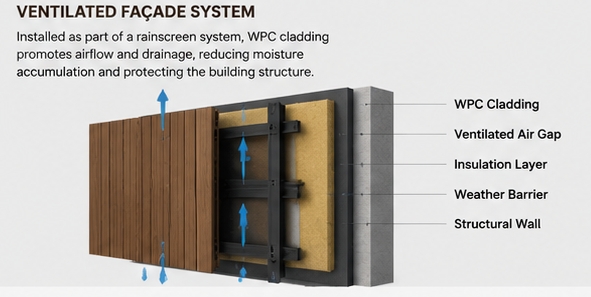
WPC cladding is commonly installed using ventilated rainscreen principles. This system creates a continuous air gap between the exterior panels and the building structure, allowing natural airflow and moisture drainage.
This design reduces moisture accumulation, improves drying efficiency after rainfall, and enhances the durability of the overall building envelope. It also contributes to energy efficiency by reducing heat transfer through the external wall system.
4. Installation Systems and Construction Efficiency
Modern WPC cladding systems are designed for efficient installation using modular profiles, interlocking joints, and concealed fastening systems. These features reduce on-site cutting and finishing work, improving installation consistency and reducing labor dependency.
Compared with traditional timber cladding, WPC systems simplify the installation process and reduce the need for surface treatment such as painting or sealing after installation.
Installation Characteristics Summary
- Pre-finished surface reduces on-site work
- Interlocking profiles improve alignment accuracy
- Hidden fixing systems enhance façade aesthetics
- Suitable for prefabricated and modular construction systems
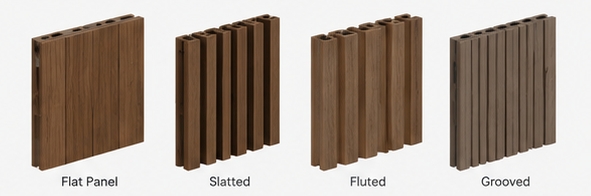
5. Types of WPC Wall Cladding Systems
- Co-extruded WPC Wall Panels: Enhanced surface protection for long-term outdoor use
- Wholesale Coextruded WPC Fluted Panels: Decorative façade systems for vertical or horizontal design
- Solid Structural WPC Boards: Higher density panels for commercial building envelopes
- Slatted WPC Façade Systems: Linear architectural aesthetics for modern design concepts
6. Application Areas in Commercial Construction
WPC wall cladding is widely applied across multiple building types due to its balance of performance and design flexibility.
- Hospitality buildings such as hotels and resorts
- Commercial office towers and business parks
- Retail façades and shopping complexes
- Residential apartment developments
- Public infrastructure and institutional buildings
In architectural design, WPC systems are often selected for projects that require a natural wood appearance without the maintenance challenges associated with real timber.
7. Material Comparison and Performance Evaluation
| Material | Installation Efficiency | Maintenance Requirement | Aesthetic Characteristics | Outdoor Durability |
|---|---|---|---|---|
| Natural Timber | Labor-intensive installation and finishing | High maintenance frequency | Natural appearance, prone to aging | Limited resistance to moisture and UV exposure |
| ACP Panels | Moderate installation complexity | Low maintenance requirements | Modern industrial appearance | Good weather resistance, limited insulation performance |
| WPC Cladding | Modular and efficient installation system | Low maintenance lifecycle | Wood-like architectural finish | Balanced resistance to environmental exposure |
8. Sustainability and Environmental Considerations
WPC materials are often manufactured using recycled wood fibers and recycled plastics, contributing to resource efficiency and reducing demand for virgin timber materials. This makes WPC a more sustainable option in façade engineering compared with traditional hardwood systems.
In addition, the long service life and reduced maintenance requirements contribute to lower lifecycle environmental impact in commercial construction projects.
9. Product Application Keywords (Long-tail SEO)
This article is relevant to the following product categories:
- Co-extruded WPC wall cladding panels for exterior commercial façades
- Fluted WPC wall cladding systems for architectural building design
- Weather-resistant WPC façade cladding boards for outdoor construction
10. Frequently Asked Questions (FAQ)
Is WPC wall cladding suitable for long-term outdoor use?
Yes. WPC is designed for exterior applications and performs well when installed correctly in ventilated façade systems.
How long does WPC cladding last?
Depending on material quality and installation conditions, WPC cladding can typically last 15–25 years in commercial applications.
Can WPC replace traditional timber façade systems?
In many cases, yes. WPC provides a similar aesthetic appearance with significantly reduced maintenance requirements and improved environmental resistance.
Conclusion
WPC wall cladding has become an important material in modern façade engineering due to its combination of durability, design flexibility, and installation efficiency. As commercial construction continues to prioritize lifecycle cost optimization and sustainable building materials, Factory Direct WPC Cladding Boards and systems are expected to maintain strong adoption across global architectural markets.
- How to Calculate WPC Decking Quantities for Large Projects: Board Coverage, Waste and Accessories
- WPC Decking for Rooftop Terraces: Load Planning, Drainage and Waterproofing Risks
- What Technical Documents Should You Request from a WPC Wall Cladding Manufacturer?
- How to Maintain WPC Wall Cladding Color Consistency in Large Projects
- How to Calculate WPC Wall Cladding Quantities: Panel Coverage, Cutting Waste and Accessories
- WPC Exterior Wall Cladding for Building Renovation: How to Check Substrates, Fixings and Ventilation
- WPC Decking for Hotels and Resorts: How to Choose Materials for Outdoor Areas
- WPC Decking for Commercial Projects: How to Specify Boards for Traffic and Climate