

Future-Proofing Commercial Exteriors: Surviving Extreme Heat, Fire, and Hurricane Winds

Author
With years of experience in exterior building materials, I specialize in advanced wood-plastic composite (WPC) technologies. My goal is to help architects, contractors, and project managers navigate the complexities of modern decking solutions. By bridging the gap between structural engineering and sustainable design, I share practical insights to ensure your outdoor projects achieve maximum durability and the best possible ROI.
Alex Carter


When specifying exterior materials for commercial developments, architects and procurement managers must evaluate threats that extend far beyond simple moisture management. A building envelope is subjected to a relentless assault from the environment: decades of intense solar radiation, extreme dynamic wind pressures, and the ever-present, catastrophic risk of exterior fires. Selecting a facade material is not merely an aesthetic choice; it is a critical exercise in long-term risk mitigation.
Traditional timber, while visually appealing, chemically degrades under sunlight and acts as a highly combustible fuel source. Conversely, basic unreinforced plastics become dangerously brittle and fade unevenly within a few short seasons. To meet the stringent demands of modern building codes, developers are increasingly turning to highly engineered composites. This technical briefing explores the advanced material science that makes premium WPC wall cladding capable of surviving the harshest environmental extremes while maintaining strict structural and safety compliance.
Combating Photodegradation: The UV Challenge
The most visually destructive force acting on any commercial facade is ultraviolet (UV) radiation. When natural wood is exposed to sunlight, UV rays actively break down the lignin—the organic polymer that binds wood fibers together—causing the wood to rapidly lose its color and turn a weathered, oxidized silver-gray. In low-grade synthetic plastics, UV radiation severs the polymer chains, leading to severe chalking, micro-cracking, and a complete loss of impact strength.
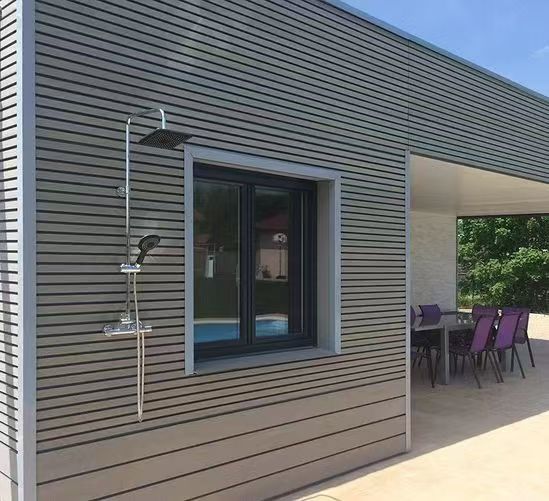
To combat this, leading manufacturers utilize co-extrusion technology to produce UV Resistant WPC Wall Cladding. During the manufacturing process, a high-density polyethylene (HDPE) core is simultaneously extruded with an advanced, 360-degree polymer shield. This outer shield is heavily saturated with automotive-grade UV inhibitors, anti-oxidants, and inorganic color pigments. These additives act as a microscopic sunscreen, absorbing and dissipating the destructive solar energy before it can penetrate the material's structural core. The result is an architectural envelope that maintains highly stable, rich coloration for decades, completely eliminating the astronomical operational expenditure (OPEX) of bi-annual re-staining and chemical sealing.
Fire Retardancy and Code Compliance
Fire safety is the absolute highest priority in modern commercial architecture, particularly for high-density residential complexes, public facilities, and mid-rise structures. The exterior facade plays a critical role in preventing the vertical spread of flames along the outside of a building. Natural timber facades provide a continuous path of combustible fuel, often requiring highly toxic, expensive, and temporary fire-retardant chemical treatments to pass inspections.
Modern composite engineering addresses this hazard directly at the formulation stage. By specifying Fire Retardant WPC Wall Cladding, developers secure a material that actively resists ignition and flame spread. During compounding, the wood fibers and polymer matrix are blended with specialized mineral fillers and non-halogenated flame retardants. When exposed to extreme heat, these compounds initiate an endothermic reaction, releasing water vapor to cool the surface and forming a protective char layer that deprives the underlying material of oxygen. This advanced chemical formulation allows premium WPC panels to achieve stringent international fire classifications (such as EN 13501 Class B or ASTM E84 Class A/B), providing critical evacuation time and minimizing catastrophic structural damage.
Structural Deflection and Wind Load Management
As buildings scale vertically, or in coastal regions prone to severe weather, the kinetic energy exerted by wind loads becomes a major engineering hurdle. A facade must not only stay attached to the building, but it must also resist excessive bending (deflection) which can cause fastener fatigue, noise, and eventual material shear.
Hollow or low-density PVC siding often fails under high wind suction, ripping away from the substructure. To ensure absolute physical security, commercial architects rely on High Density WPC Wall Cladding. The heavy compression of recycled hardwood fibers combined with robust thermoplastic resins creates a material with exceptional flexural strength and rigidity. When properly installed on a commercial batten grid using stainless steel concealed clips, the high-density WPC transfers the dynamic wind loads efficiently into the primary building structure without shattering or permanently deforming.
| Engineering Hazard | Natural Timber / Basic PVC Reaction | Premium WPC Cladding Solution |
|---|---|---|
| Prolonged UV Exposure | Rapid silvering, lignin breakdown, surface chalking, and micro-cracking. | Polymer shield with UV inhibitors ensures decade-long color stability and structural integrity. |
| Fire Ignition Risk | Highly combustible; acts as vertical fuel spreading flames up the building envelope. | Mineral fillers and retardants create a char layer, suppressing flame spread to meet strict commercial codes. |
| Dynamic Wind Loads | High deflection (bending); thin plastics shatter, while wood splinters under fastener stress. | High-density core provides extreme flexural strength, safely deflecting wind pressure. |
| Impact Resistance | Susceptible to severe denting from hail, flying debris, or blunt force at ground level. | Rigid coextruded shell easily absorbs heavy impacts without bruising or fracturing. |
The Intelligent Procurement Choice
The true cost of a commercial facade is calculated over a multi-decade operational lifecycle. Materials that look beautiful upon initial installation but lack robust chemical and structural engineering quickly transform into massive financial liabilities. By demanding composite materials explicitly engineered for severe UV resistance, verifiable fire retardancy, and high-density impact strength, property developers secure a facade that actively protects the building's occupants and drastically maximizes the long-term return on investment.
- How to Calculate WPC Decking Quantities for Large Projects: Board Coverage, Waste and Accessories
- WPC Decking for Rooftop Terraces: Load Planning, Drainage and Waterproofing Risks
- What Technical Documents Should You Request from a WPC Wall Cladding Manufacturer?
- How to Maintain WPC Wall Cladding Color Consistency in Large Projects
- How to Calculate WPC Wall Cladding Quantities: Panel Coverage, Cutting Waste and Accessories
- WPC Exterior Wall Cladding for Building Renovation: How to Check Substrates, Fixings and Ventilation
- WPC Decking for Hotels and Resorts: How to Choose Materials for Outdoor Areas
- WPC Decking for Commercial Projects: How to Specify Boards for Traffic and Climate