

How to Choose a Waterproof WPC Fence for Outdoor Projects?


Author
With years of experience in exterior building materials, I specialize in advanced wood-plastic composite (WPC) technologies. My goal is to help architects, contractors, and project managers navigate the complexities of modern decking solutions. By bridging the gap between structural engineering and sustainable design, I share practical insights to ensure your outdoor projects achieve maximum durability and the best possible ROI.
Alex Carter


Choosing a WPC fence for an outdoor project is not simply a matter of selecting a color or wood-grain texture. A fence installed outdoors must deal with rain, humidity, UV exposure, temperature changes, dirt, impact, and repeated cleaning. For residential projects, these factors affect appearance and maintenance. For commercial and wholesale projects, they also affect replacement costs, installation schedules, and long-term project performance.
The term “waterproof WPC fence” is also used very broadly. Different WPC formulations and manufacturing processes can have very different levels of moisture resistance. A good specification should therefore look beyond marketing terms and examine the board structure, protective layer, water resistance, UV performance, dimensions, installation system, and expected operating environment.
1. Start With the Outdoor Environment
The first step is to identify what the fence will actually face after installation. A garden fence in a relatively dry climate does not have the same requirements as a privacy fence beside a swimming pool, a coastal property, or a commercial development exposed to strong sunlight.
| Project Environment | Main Risk | Important Specification |
|---|---|---|
| Residential garden | Rain, staining, fading | Moisture and UV resistance |
| Poolside area | Continuous moisture and cleaning | Low water absorption and easy-clean surface |
| Coastal property | Humidity, salt air and UV | Weather-resistant surface and corrosion-resistant hardware |
| Commercial perimeter | Impact, frequent use and maintenance | Strong board structure and reinforced posts |
| High-UV region | Color fading and surface degradation | UV-stabilized co-extruded protective layer |
This environmental assessment should happen before choosing the appearance. A wood-grain finish may look attractive, but the surface technology behind that finish is more important for long-term outdoor performance.
2. Check Whether the WPC Fence Is Truly Designed for Moisture Exposure
WPC combines wood fiber with polymer materials, but that does not mean every WPC product has identical moisture resistance. The composition, density, extrusion process, additives, surface treatment, and edge protection all influence performance.
For buyers comparing products, Waterproof WPC Fence for Outdoors should be treated as a specification requirement rather than simply a product description.
One of the most important questions is whether the fence is standard single-layer WPC or co-extruded WPC. In a co-extrusion process, a protective polymer layer is formed around the composite core during manufacturing. This creates a more resistant exterior against moisture, UV exposure, staining, and surface wear.
| Feature | Standard WPC | Co-Extrusion WPC |
|---|---|---|
| Composite core | Exposed composite structure | Composite core with protective outer layer |
| Moisture protection | Depends strongly on formulation and surface | Higher surface protection |
| UV resistance | Depends on formulation | Enhanced by the protective cap layer |
| Stain resistance | Moderate to good | Generally better surface protection |
| Best application | Standard outdoor applications | High-exposure and premium outdoor projects |
3. Understand the Importance of the Co-Extrusion Layer
For projects where moisture and sunlight are major concerns, the outer layer deserves particular attention. Modern co-extruded WPC fencing uses a polymer cap to create a protective barrier between the composite core and the outdoor environment.
The thickness of this layer can vary considerably between manufacturers. Published products in the current market range from approximately 0.3 mm to 1 mm or more, so buyers should ask for the actual specification rather than assuming that every co-extruded fence uses the same construction.
More importantly, ask how the performance has been tested. Useful documentation may include accelerated weathering tests, water absorption data, UV resistance results, dimensional information, and material composition.
For a B2B project, a supplier should be able to provide more than a statement such as “waterproof” or “UV resistant.” A technical datasheet gives the purchasing team something measurable to compare between suppliers.
4. Evaluate Water Absorption and Drainage Together
Water resistance is not determined by the panel alone. The complete fence system matters.
Water can collect at the bottom of panels, inside poorly designed profiles, around posts, or near fasteners. Even a highly moisture-resistant panel can experience unnecessary stress if the installation prevents drainage.
For outdoor projects, check:
- Water absorption test results where available.
- Whether the panel has a protective outer layer.
- Whether the profile allows water to drain naturally.
- Whether the bottom of the fence is kept away from standing water.
- Whether posts and internal reinforcement are suitable for outdoor use.
- Whether the fasteners and brackets are corrosion resistant.
For example, some current WPC fencing specifications report water absorption below 1% under ASTM D570 testing, but this should never be treated as a universal WPC standard. Buyers should request the actual test report for the product being purchased.
5. Do Not Ignore UV Resistance
Waterproofing solves only one part of the outdoor durability problem. A fence can remain structurally sound while its surface gradually loses color or develops visible weathering.
UV performance is particularly important for south-facing walls, open commercial sites, pool areas, balconies, and other locations with long periods of direct sunlight.
When comparing suppliers, look for measurable testing rather than vague phrases such as “anti-UV.” Some manufacturers specify accelerated QUV testing, while others provide color-change data such as ΔE values. These figures are more useful for technical comparison than a simple “UV resistant” label.
| UV Specification | What It Tells the Buyer |
|---|---|
| QUV exposure time | How the product performs under accelerated weathering conditions |
| Color change / ΔE | Provides a measurable indication of color stability |
| UV stabilizer specification | Shows whether UV protection is incorporated into the material system |
| Co-extrusion layer | Adds a protective surface against outdoor exposure |
6. Choose the Right Wood-Grain Finish for the Project
Appearance still matters, particularly for residential developments, hotels, resorts, villas, restaurants, and landscaped commercial properties. However, wood-grain appearance should be evaluated together with surface durability.
A high-quality Wood Grain Outdoor WPC Fence should provide a convincing timber appearance without requiring the regular staining, sealing, and repainting associated with many traditional wood fences.
Ask for physical samples before placing a large order. Check the grain depth, color consistency, surface texture, edge finish, and appearance under both direct and indirect light.
For wholesale projects, also confirm whether the manufacturer can maintain color consistency between production batches. A small color difference may not matter for a single residential fence, but it can become noticeable across hundreds of meters of fencing.
7. Match Fence Structure to Height, Wind, and Privacy Requirements
Waterproof panels alone do not make a reliable fence. The posts, rails, connectors, reinforcement, and foundation determine how the completed system behaves under wind and impact.
| Requirement | Recommended Approach |
|---|---|
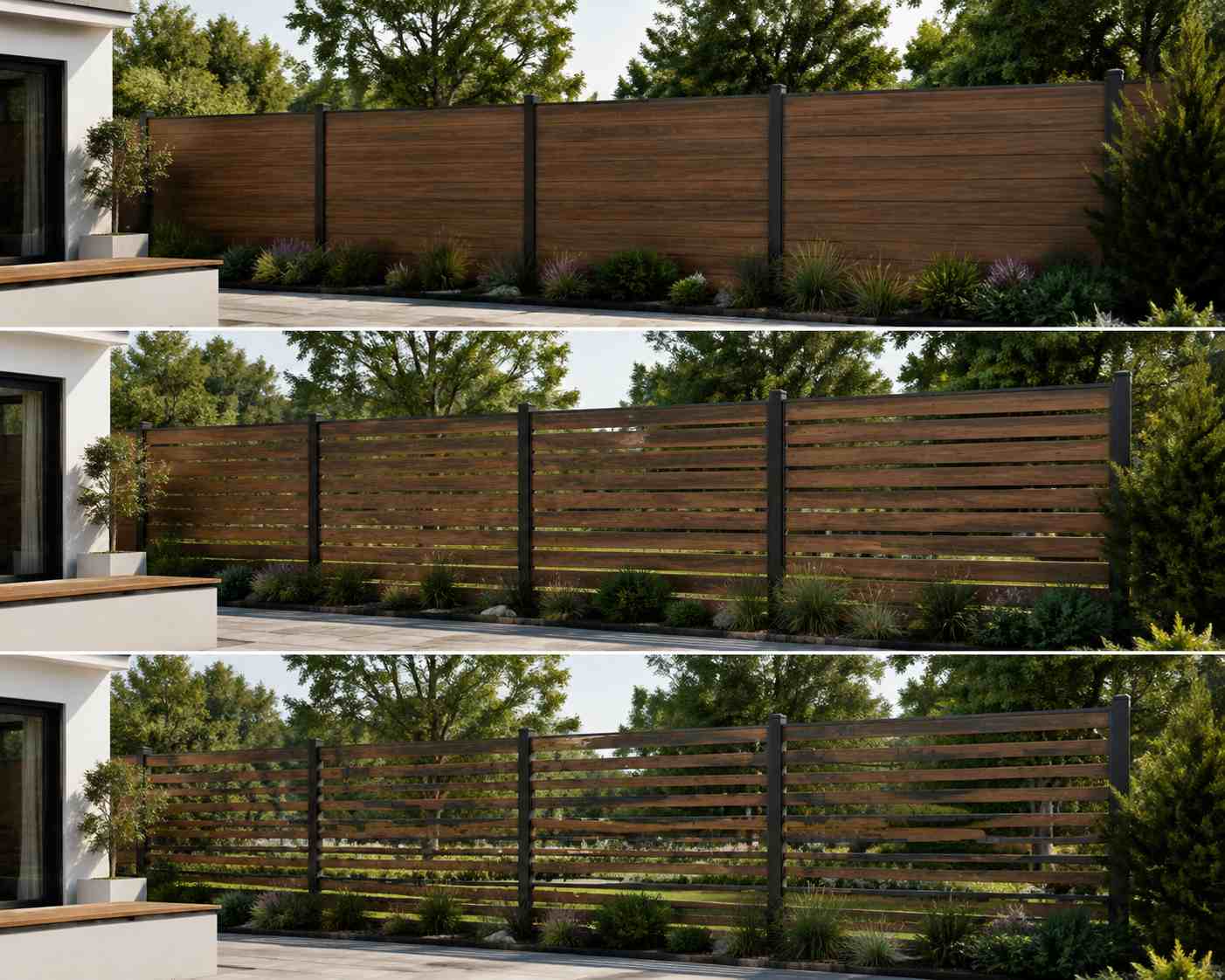
| Maximum privacy | Solid or closely interlocking horizontal panels |
| High wind exposure | Reinforced posts, suitable foundations and engineered panel spacing |
| Large commercial site | Standardized modules and consistent accessories |
| Decorative boundary | Slatted or partially open designs |
| Pool or resort project | Moisture-resistant panels with corrosion-resistant hardware |
Do not select a fence height or post spacing only from a product catalog. Local wind conditions, soil conditions, foundation design, and local building requirements can affect the final structural specification.
8. Compare Total Project Cost, Not Just Panel Price
A lower unit price does not necessarily produce a lower project cost. For commercial buyers, the total cost includes panels, posts, accessories, freight, installation labor, maintenance, replacement, and the risk of inconsistent supply.
| Cost Factor | Questions to Ask |
|---|---|
| Material | What is included in the quoted price? |
| Accessories | Are posts, rails, caps and connectors included? |
| Installation | How many components are required per fence section? |
| Maintenance | Does the surface require painting, staining or sealing? |
| Replacement | Can individual panels and accessories be replaced? |
| Supply consistency | Can the factory maintain the same profile and color for repeat orders? |
9. A Practical Specification Checklist Before Ordering
Before approving a WPC fence for a residential development, commercial landscape project, hotel, resort, or wholesale order, request the following information from the manufacturer:
- Material composition and polymer type.
- Panel dimensions and thickness.
- Co-extrusion layer thickness, if applicable.
- Water absorption test data.
- UV or accelerated weathering test results.
- Color and surface finish options.
- Post and reinforcement specifications.
- Recommended post spacing and foundation requirements.
- Available panel heights and custom dimensions.
- Installation instructions.
- Warranty terms and exclusions.
- Packaging and container-loading information for bulk orders.
For large projects, it is also worth requesting a production sample before approving the final purchase order. Compare the physical sample with the technical datasheet and make sure the final specification covers both the panel and the complete fencing system.
10. Selecting the Right WPC Fence for Different Projects
| Project Type | Priority | Recommended Fence Characteristics |
|---|---|---|
| Villa and residential garden | Appearance + privacy | Wood-grain finish, low maintenance, UV and moisture resistance |
| Hotel and resort | Appearance + durability | Co-extruded surface, consistent color, corrosion-resistant accessories |
| Commercial development | Lifecycle cost + supply | Standardized profiles, strong posts, repeat-order consistency |
| Poolside project | Moisture + maintenance | Low water absorption, easy-clean surface, corrosion-resistant hardware |
| Wholesale distribution | Consistency + logistics | Stable specifications, custom options, efficient packaging and supply |
The best WPC fence is therefore not necessarily the thickest, most expensive, or most decorative option. It is the system whose material structure, surface protection, dimensions, reinforcement, and installation method match the environment where it will be used.
For outdoor projects exposed to rain, humidity, strong sunlight, or frequent cleaning, co-extruded WPC is worth particular attention because the protective outer layer can improve resistance to moisture, UV exposure, staining, and surface wear. For buyers placing wholesale or project orders, technical documentation and physical samples provide a much stronger basis for comparison than price or appearance alone.
Frequently Asked Questions About Waterproof WPC Fences
1. Is WPC fencing completely waterproof?
WPC fencing is highly resistant to moisture, but “waterproof” should not be interpreted as meaning that every WPC product performs identically in all conditions. The material formulation, manufacturing process, surface treatment, and profile design all affect moisture resistance. For outdoor projects, buyers should check water absorption data and whether the fence uses a co-extruded protective layer.
2. How long does a WPC fence last outdoors?
A properly manufactured and installed WPC fence can provide many years of outdoor service, but actual service life depends on material quality, UV exposure, climate, installation, and maintenance. For commercial projects, ask the manufacturer for warranty terms, weathering test results, and recommended installation conditions rather than relying only on a general lifespan claim.
3. Does WPC fencing fade in direct sunlight?
WPC fencing can experience some color change after prolonged UV exposure, but UV-stabilized materials and co-extruded protective layers can significantly improve color stability. If the fence will be installed in a high-UV environment, request accelerated weathering or color-change test data before placing a large order.
4. Is co-extruded WPC fencing better for outdoor use?
For demanding outdoor applications, co-extruded WPC fencing can provide an additional layer of protection around the composite core. The outer polymer layer is designed to improve resistance to moisture, UV exposure, stains, and surface wear. It is particularly worth considering for poolside areas, coastal properties, resorts, and commercial developments.
5. Does WPC fencing require regular painting or staining?
One of the advantages of WPC fencing is its relatively low maintenance compared with many traditional wood fencing systems. Standard cleaning with water and a mild detergent is generally sufficient for routine dirt and surface contamination. However, the exact maintenance requirements depend on the product's surface finish and the surrounding environment.
6. Can WPC fences be used around swimming pools?
Yes. WPC fencing can be suitable for poolside applications because it is resistant to moisture and does not require the same type of routine sealing as conventional timber. However, the complete system should be evaluated, including the fence panels, posts, fasteners, and other metal components. Corrosion-resistant hardware is especially important in areas exposed to continuous moisture.
7. Is WPC fencing suitable for commercial and wholesale projects?
Yes. WPC fencing is commonly considered for residential developments, hotels, resorts, landscaping projects, commercial properties, and wholesale distribution. For larger orders, buyers should evaluate more than the panel price. Production capacity, color consistency, packaging, container loading, accessory availability, repeat-order stability, and technical support can have a significant impact on the total project cost.
8. Can WPC fence panels be customized in size and color?
Many WPC manufacturers offer customization options such as panel dimensions, colors, surface textures, profiles, posts, and accessories. The available options depend on the manufacturer's extrusion tooling and production capabilities. For a custom project, confirm minimum order quantities, tooling requirements, lead times, and whether the same specification can be reproduced for future orders.
9. What should I check before buying WPC fencing in bulk?
Before placing a bulk order, request a product datasheet, material specifications, water absorption data, UV or weathering test results, panel dimensions, accessory specifications, installation instructions, warranty terms, and physical samples. It is also important to confirm packaging dimensions and container-loading capacity if the project involves international shipping.
10. How do I choose between standard WPC and co-extruded WPC fencing?
Consider the project's exposure level and expected service conditions. Standard WPC may be suitable for less demanding outdoor applications where cost is a major consideration. Co-extruded WPC is generally more appropriate when the fence will face strong UV exposure, frequent moisture, staining, intensive cleaning, or higher appearance requirements. Comparing test data and the total project cost is more reliable than choosing based on price alone.
- How to Calculate WPC Decking Quantities for Large Projects: Board Coverage, Waste and Accessories
- WPC Decking for Rooftop Terraces: Load Planning, Drainage and Waterproofing Risks
- What Technical Documents Should You Request from a WPC Wall Cladding Manufacturer?
- How to Maintain WPC Wall Cladding Color Consistency in Large Projects
- How to Calculate WPC Wall Cladding Quantities: Panel Coverage, Cutting Waste and Accessories
- WPC Exterior Wall Cladding for Building Renovation: How to Check Substrates, Fixings and Ventilation
- WPC Decking for Hotels and Resorts: How to Choose Materials for Outdoor Areas
- WPC Decking for Commercial Projects: How to Specify Boards for Traffic and Climate