


Building for the Future: How Sustainable WPC Cladding Supports LEED and BREEAM Projects?


Author
With years of experience in exterior building materials, I specialize in advanced wood-plastic composite (WPC) technologies. My goal is to help architects, contractors, and project managers navigate the complexities of modern decking solutions. By bridging the gap between structural engineering and sustainable design, I share practical insights to ensure your outdoor projects achieve maximum durability and the best possible ROI.
Alex Carter


Green building has moved beyond energy-efficient lighting, insulation, and HVAC systems. For architects, developers, contractors, and procurement teams, the materials selected for a project are increasingly evaluated according to their environmental impact, transparency, durability, and end-of-life potential.
This shift makes wall cladding an important part of the sustainability discussion. WPC (Wood Plastic Composite) combines wood-based material with polymer components to create a durable alternative to some conventional exterior and interior finishes. However, simply describing WPC as an “eco-friendly material” is not enough for a commercial project pursuing LEED or BREEAM certification.
The more useful question is: What environmental information can a WPC product provide, and how can project teams use that information during certification and procurement?
That distinction matters. LEED and BREEAM evaluate the performance of the building and its products within defined assessment frameworks. A WPC product does not automatically earn certification points simply because it contains recycled material or replaces another material. Instead, its verified characteristics and documentation may contribute to specific project strategies.
Why Material Selection Matters in Green Building
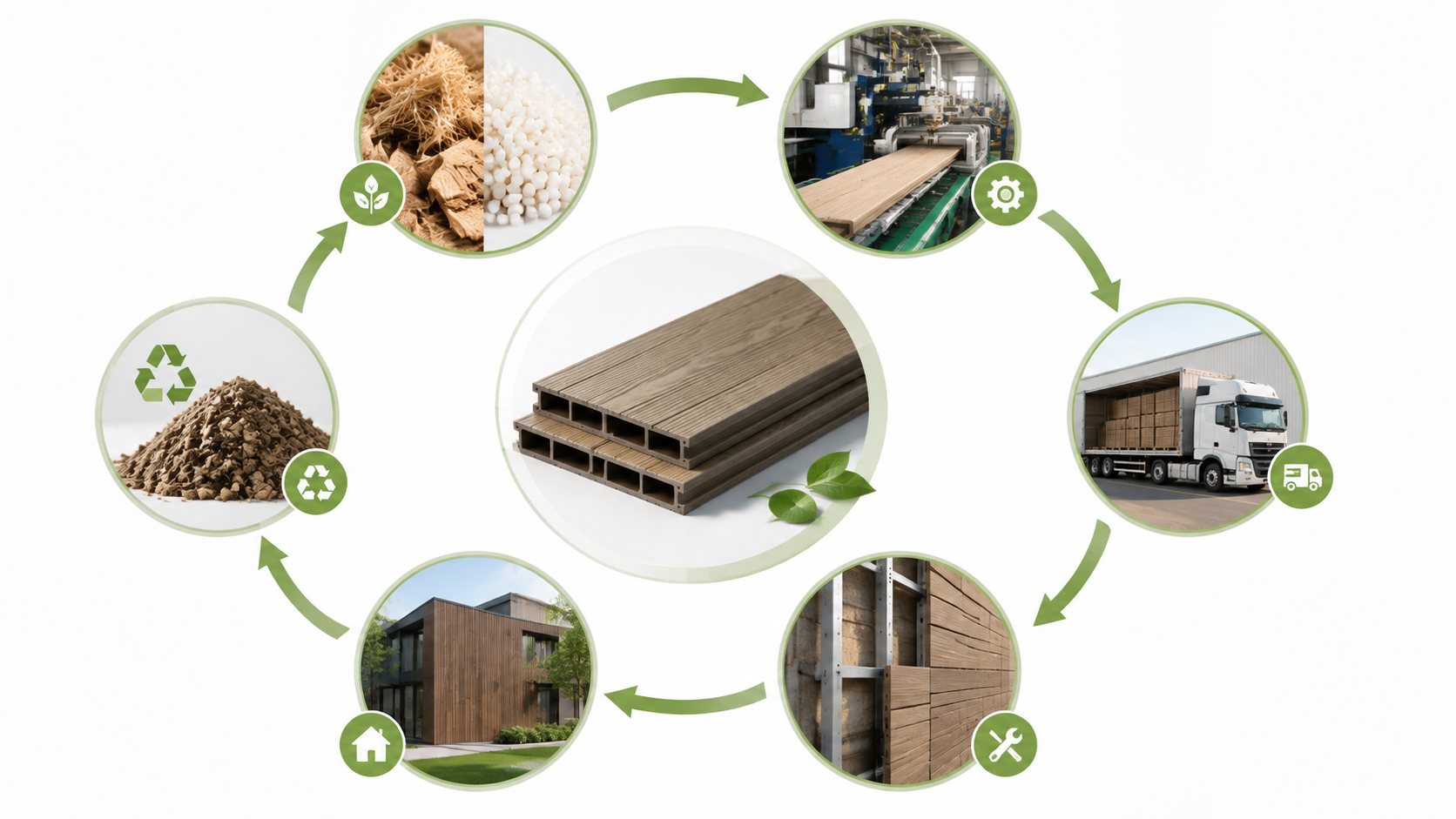
Building materials carry environmental impacts throughout their life cycle, from raw material extraction and manufacturing to transportation, installation, maintenance, and end-of-life treatment. For large projects, even a relatively small change in material specification can affect the overall environmental profile of the building.
For architects and developers, choosing Sustainable WPC Wall Cladding should therefore involve more than comparing colors and surface finishes. The project team should consider material composition, recycled content, manufacturing processes, expected service life, environmental documentation, and the conditions under which the product will be installed.
LEED and BREEAM both encourage project teams to consider environmental performance at the material and building level. Depending on the certification version and project pathway, factors such as embodied carbon, responsible sourcing, recycled content, environmental product information, durability, and resource efficiency can all become relevant to material selection.
| Sustainability Factor | What Project Teams Should Evaluate | Why It Matters for WPC |
|---|---|---|
| Recycled Content | Percentage and type of recycled material | Can reduce dependence on virgin feedstocks |
| Embodied Carbon | Manufacturing and life-cycle carbon impacts | Provides a basis for comparing material options |
| Responsible Sourcing | Traceability and supplier practices | Helps document the supply chain |
| Durability | Expected service life and maintenance requirements | Longer service can reduce replacement frequency |
| End of Life | Reuse, recycling, take-back, or disposal options | Supports circular material strategies |
How WPC Can Contribute to a Sustainable Material Strategy
WPC should be evaluated as a complete product system rather than simply as a substitute for natural timber. Its environmental value depends on the formulation, recycled content, manufacturing process, transportation, expected service life, maintenance requirements, and end-of-life pathway.
For example, a manufacturer may use post-consumer or post-industrial polymer content and wood fiber from controlled sources. However, procurement teams should ask for documented percentages instead of relying on general claims such as “recycled” or “green.”
Recycled content can be particularly relevant when a project is evaluating circularity and resource efficiency. However, the percentage should be supported by manufacturer documentation or other appropriate verification rather than being presented as an unsupported marketing claim.
For a project team, useful information includes:
- Total recycled content by weight
- Post-consumer recycled content percentage
- Pre-consumer recycled content percentage
- Source of recycled feedstock
- Verification or supporting documentation
- Product-specific technical data
Recycled Content: Useful, but Not the Whole Story
Recycled content is one of the easiest sustainability characteristics for a buyer to understand, but it should not be used as the only measure of environmental performance.
When reviewing Recycled WPC Cladding Panels, procurement teams should distinguish between post-consumer and pre-consumer material and confirm how the manufacturer calculates the recycled content percentage.
The project team should also consider where the recycled material comes from, how it is processed, and whether the supplier can provide consistent documentation for the products being quoted. This is especially important for large projects where sustainability documentation may need to be reviewed by architects, contractors, consultants, or certification specialists.
A high recycled-content percentage can be useful, but it should be considered alongside durability, manufacturing impacts, transportation, maintenance, and end-of-life options. A balanced assessment provides a more reliable picture of the product's environmental performance.
EPDs and Life-Cycle Data Make Product Comparisons More Meaningful
One of the biggest problems with sustainability claims is that different manufacturers may use completely different methods to describe environmental performance. An Environmental Product Declaration (EPD) provides a structured way to communicate life-cycle environmental information.
For a project pursuing green certification, an EPD can help the design team compare products using environmental indicators rather than relying only on marketing claims. Depending on the certification pathway, EPD and life-cycle information can support more transparent material-selection decisions.
Life-cycle assessment can consider multiple stages of a product's environmental impact, including raw material extraction, manufacturing, transportation, installation, use, and end of life. This broader view prevents project teams from judging a product solely by one characteristic such as recycled content.
| Document / Data | What It Helps Demonstrate | Priority for Large Projects |
|---|---|---|
| Product Technical Data Sheet | Composition and performance | High |
| Recycled Content Statement | Verified recycled material content | High |
| EPD | Life-cycle environmental impacts | Very High |
| LCA Information | Whole-life environmental assessment | Very High |
| Responsible Sourcing Documentation | Supply-chain transparency | High |
LEED and BREEAM: Similar Goal, Different Assessment Logic
LEED and BREEAM are both comprehensive green building systems, but project teams should not assume that a product qualifying under one system automatically qualifies under the other.
LEED considers areas such as carbon reduction, material transparency, circularity, responsible procurement, and environmental product information. BREEAM also considers whole-life carbon, material selection, responsible sourcing, durability, resilience, and resource efficiency.
The exact requirements depend on the certification version, project type, location, and assessment pathway. For this reason, suppliers should avoid making blanket claims such as “LEED-certified WPC” unless the specific product and claim are properly documented.
| Project Question | LEED-Oriented Consideration | BREEAM-Oriented Consideration |
|---|---|---|
| What is the environmental impact? | Embodied carbon, LCA and EPD information | Whole-life environmental impact and LCA |
| Where do materials come from? | Responsible sourcing and product documentation | Responsible sourcing and supply-chain assessment |
| Can material use become more circular? | Recycled content, reuse and circularity strategies | Resource efficiency, waste reduction and circular approaches |
| How long will the product last? | Relevant to life-cycle and material selection decisions | Durability and service-life considerations are explicitly relevant |
Responsible Sourcing Should Start Before Procurement
Sustainability documentation becomes much easier when it is collected before the purchase order is issued.
For example, a project specification can require suppliers to submit recycled-content declarations, EPDs, responsible sourcing information, technical performance data, and relevant certifications as part of the material submittal package.
Responsible sourcing is particularly important for large construction projects because the supply chain can involve multiple raw-material suppliers, processors, manufacturers, distributors, and installers.
For WPC procurement, the project team should therefore look beyond the visible surface. The manufacturer, raw-material sources, manufacturing location, formulation, recycled content, packaging, transportation, expected service life, and end-of-life options can all influence the sustainability assessment.
Durability Is an Environmental Consideration Too
A sustainable material is not only one that contains recycled content. It also needs to perform adequately for its intended application.
If exterior cladding requires frequent replacement because of premature degradation, the environmental benefits of the original material can be weakened by additional manufacturing, transportation, installation, and disposal.
For this reason, buyers should evaluate UV resistance, moisture resistance, dimensional stability, surface durability, maintenance requirements, and expected service life alongside recycled content.
This is particularly important for exterior projects. A product specified for a façade should be assessed under the actual climate and exposure conditions rather than selected solely on appearance.
For architects specifying Durable WPC Exterior Wall Panels, the objective should be to balance environmental information with real-world service performance. A product that performs reliably over a long service period may reduce the need for replacement materials and associated construction activities.
What Procurement Teams Should Request from a WPC Supplier
For larger commercial, hospitality, residential, and public projects, a supplier's sustainability documentation can be just as important as the product sample.
| Information to Request | Purpose |
|---|---|
| Product Composition | Understand wood, polymer and additive content |
| Recycled Content | Verify post-consumer and pre-consumer content |
| EPD | Support life-cycle environmental assessment |
| LCA Information | Provide environmental impact data for project calculations |
| Responsible Sourcing | Document material and supply-chain practices |
| Durability Testing | Verify performance under intended conditions |
| Installation Documentation | Avoid premature failure caused by incorrect installation |
| End-of-Life Information | Evaluate recycling, reuse or disposal pathways |
How to Build a Strong Sustainability File for a WPC Product
A useful sustainability file should allow an architect, contractor, sustainability consultant, or purchasing manager to verify the product without repeatedly requesting basic information from the manufacturer.
A practical structure is:
- Product identification: product name, model, dimensions and intended application.
- Material information: composition and recycled-content percentages.
- Environmental documentation: EPD, LCA or other verified environmental information where available.
- Performance data: durability, moisture, UV, fire and dimensional-stability information as applicable.
- Sourcing information: manufacturing location and relevant responsible-sourcing documentation.
- Installation information: approved installation method, support requirements and maintenance instructions.
- End-of-life information: recycling, reuse, take-back or disposal guidance where applicable.
This approach is especially useful during tendering. Instead of asking suppliers to make broad environmental claims, project teams can compare documented characteristics using the same checklist.
From “Eco-Friendly” Claims to Verifiable Project Data
The green building market is becoming increasingly data-driven. Architects and developers are increasingly expected to demonstrate why a material was selected rather than simply describe it as sustainable.
For WPC manufacturers, this creates an opportunity to compete through transparency. Recycled content, life-cycle information, responsible sourcing, durability testing, and clear technical documentation can make a product much easier to evaluate during a major project.
For project teams, the lesson is equally practical: do not ask only whether a WPC product is environmentally friendly. Ask what has been measured, how it has been verified, and how the information fits the project's specific LEED or BREEAM assessment pathway.
The strongest material strategy is rarely based on one environmental characteristic. It comes from combining verified material data, appropriate product performance, responsible sourcing, durability, and a clear plan for how the product fits into the building's overall sustainability strategy.
For architects, developers, contractors, and procurement teams, this approach turns WPC selection from a simple finish decision into a documented part of the project's broader sustainability strategy.
- How to Calculate WPC Decking Quantities for Large Projects: Board Coverage, Waste and Accessories
- WPC Decking for Rooftop Terraces: Load Planning, Drainage and Waterproofing Risks
- What Technical Documents Should You Request from a WPC Wall Cladding Manufacturer?
- How to Maintain WPC Wall Cladding Color Consistency in Large Projects
- How to Calculate WPC Wall Cladding Quantities: Panel Coverage, Cutting Waste and Accessories
- WPC Exterior Wall Cladding for Building Renovation: How to Check Substrates, Fixings and Ventilation
- WPC Decking for Hotels and Resorts: How to Choose Materials for Outdoor Areas
- WPC Decking for Commercial Projects: How to Specify Boards for Traffic and Climate